Humanoid Robot Stocks? The Real Bottleneck Is the Reducer
The first part to run short as humanoids scale is the precision reducer and actuator inside each joint. We checked four listed makers of those parts and of rare-earth magnets against filings and press reports.
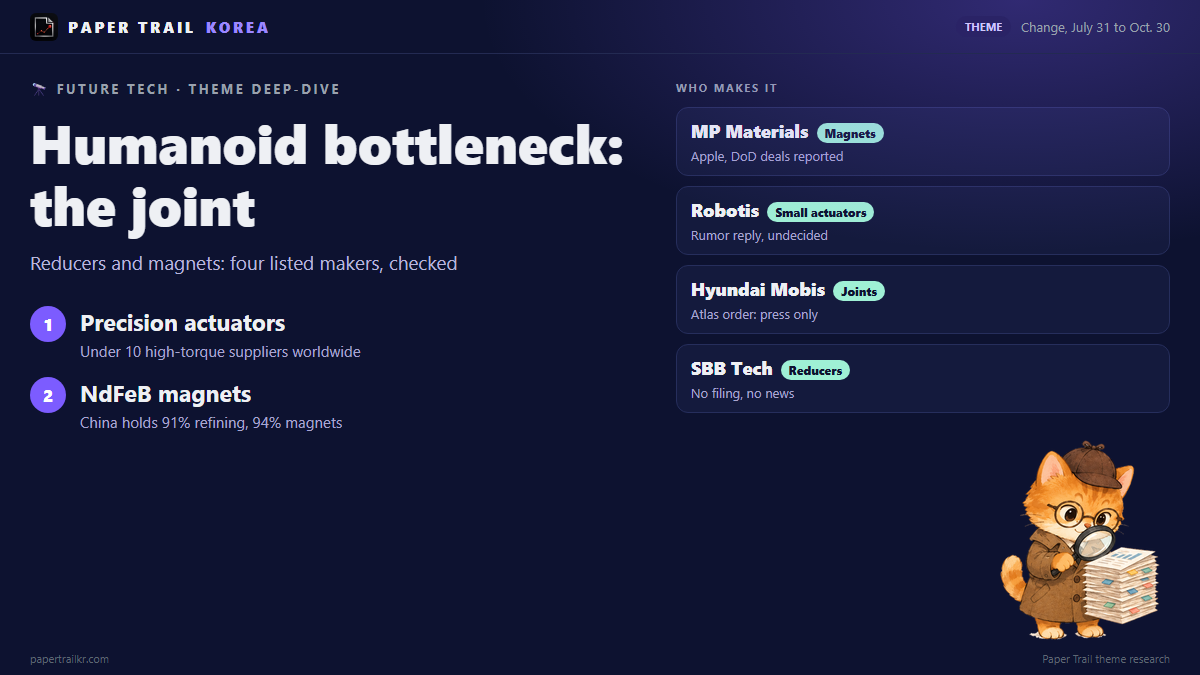
Seoul — KB Securities estimates that Hyundai Mobis alone could book 166 trillion won in humanoid actuator (the drive unit that moves a robot joint) revenue and 13 trillion won in operating profit by 2035, according to Hankyung. Paper Trail's own theme research, dated Oct. 31, 2026 22:09 KST, points to the precision reducer inside the joint as the part likely to run short first. The basis is a McKinsey estimate that fewer than 10 companies worldwide make high-torque actuators and reducers.
At a glance
| Stock | Part it covers | Nature of the news | Evidence | What to check next |
|---|---|---|---|---|
| MP Materials | Rare-earth permanent magnets (NdFeB) | Substance (orders, revenue) | Press only | Whether robot volumes appear in contracts; operating margin turning positive |
| Robotis | Small actuator modules (Dynamixel) | Expectation | Press only | Supply-contract filings from large customers; quarterly loss |
| Hyundai Mobis | Humanoid joint actuators | Expectation | Press only | Whether robot parts revenue is reported separately |
| SBB Tech | Precision harmonic reducers | Expectation | None | Whether the Taiwanese robot maker's test becomes a supply contract |
Bottleneck 1: Precision reducers and actuators, with very few makers
An actuator bundles a motor, a reducer and screw-type parts into one joint module. The reducer turns the motor's fast spin into slower, stronger force. A planetary roller screw (a precision screw that turns rotation into straight-line force) pushes and pulls the limbs. iM Securities puts the module at 70–80% of a robot's cost and Shinhan at 40–60%. Hyundai Mobis uses 60% in its own estimate.
Supply is thin because the barriers are high. McKinsey counts fewer than 10 makers of high-torque actuators and reducers worldwide. Japan's Harmonic Drive and Nabtesco, Germany's Schaeffler, and Switzerland's GSA and Rollvis have held the market for more than 50 years. New lines take years, and one report says Harmonic Drive's order backlog is already full into 2027 and beyond.
Units per robot raise the stakes. According to humanoid.guide, one Tesla Optimus carries 28 structural actuators, 14–16 planetary roller screws and about 14 harmonic reducers. Each hand needs about 20 coreless motors (small motors without an iron core). An industrial robot arm has six axes, so the same parts are needed several to dozens of times over.
Bottleneck 2: Rare-earth magnets, with refining and processing in China
Servo motors (motors with precise position control) rely on NdFeB (neodymium-iron-boron) magnets. China holds 59% of rare-earth mining, 91% of refining and 94% of magnet processing, according to Bernstein and TheNextWeb. MP Materials' CEO has said securing NdPr oxide will be a structural constraint for non-Chinese magnet output over the next five years. China's 2025 export controls delayed Tesla Optimus production.
Each robot needs 2–4.5 kg of NdFeB magnet and 30 or more servo motors. An electric vehicle uses one or two drive motors, so the motor count alone is at least ten times higher.
MP Materials, contracts exist but the robot share is not visible yet
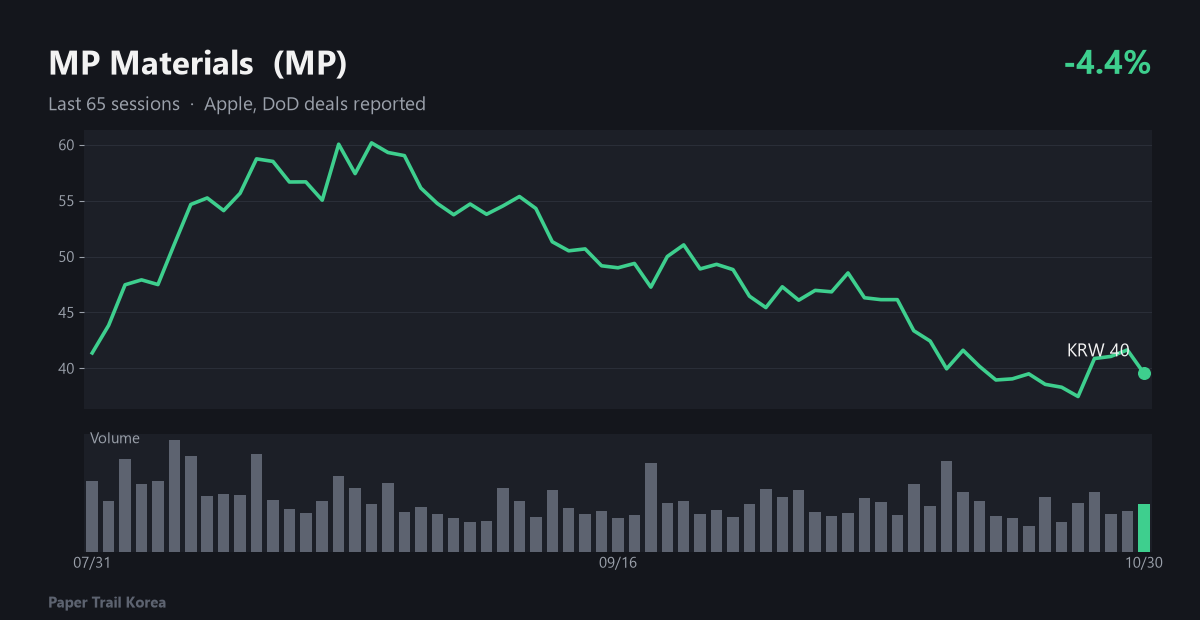
MP Materials links rare-earth mining to magnet production inside one U.S. company. Paper Trail's research record lists a $500 million Apple contract, a $400 million Department of Defense contract (reported around the second-quarter earnings call) and a long-term GM agreement. The CEO named physical AI (AI that acts in the real world through robots) as a key demand source. But the counterparties are Apple, the Pentagon and GM, so the humanoid share cannot be read from this data. Per the research record, revenue grew 119.7%, and last quarter's gross margin was 0.8%, up 18.1 points from the prior quarter. The net margin is -14.6%, still a loss. The stock is down 4.4% from its July 31 close and 34.2% below its period high. Recent SEC filings are a major-holder report (Schedule 13G/A, Oct. 27) and an insider transaction report (Form 4, Oct. 13). None concerns a contract.
Two things to check. One is whether new long-term purchase contracts from the Pentagon, automakers or Apple appear. The other is whether next quarter's operating margin turns positive or the loss narrows clearly. The case weakens if China eases export controls and prices drop sharply, if a non-Chinese rival such as Lynas visibly expands magnet capacity, or if existing contracts are cancelled or cut.
Robotis, small joint modules are the business, and it is still loss-making
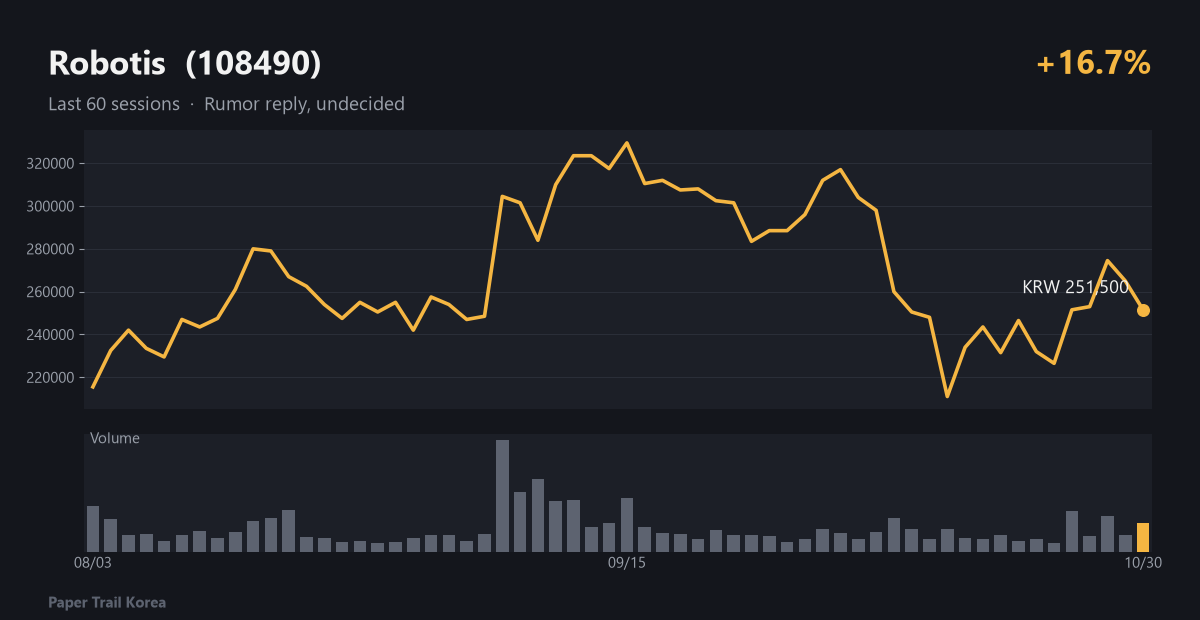
Robotis makes Dynamixel, a small actuator module. In a report cited in our research notes (Daum/MTN), actuators were 98% of first-half revenue (26.7 billion won) and exports were 76%. The notes do not state which period that report covers. These are not the large high-torque actuators McKinsey describes, and the research record has no sign of a multi-year order backlog like the big reducer makers'. The net margin is -7.8% and free cash flow is negative. The stock is up 16.7% from its Aug. 3 close and 23.7% below its period high. Among filings from the past week is a Oct. 28 response to a rumor or report, marked 'undetermined'. Only the title is available; the contents are not in our data. There were also stock-futures price-limit expansion filings, two upward (Oct. 26, 28) and two downward (Oct. 12, 15), and a new-share listing from stock-option exercises (Oct. 20). On Nov. 1, Electronic Times reported on the $399 'duck robot' that Robotis is developing with France's Pollen Robotics.
Check for supply-contract filings from automakers or large humanoid makers, for a narrower quarterly loss, and for gross-margin gains that carry into the next quarter. The latest gross margin is 56.2%, up 5.0 points on the quarter but down 4.9 points on the year. The case weakens if low-priced rivals enter small actuators, if the 2026 operating loss widens as guided, or if a major export customer leaves.
Hyundai Mobis, the Atlas joint order is still at the report stage
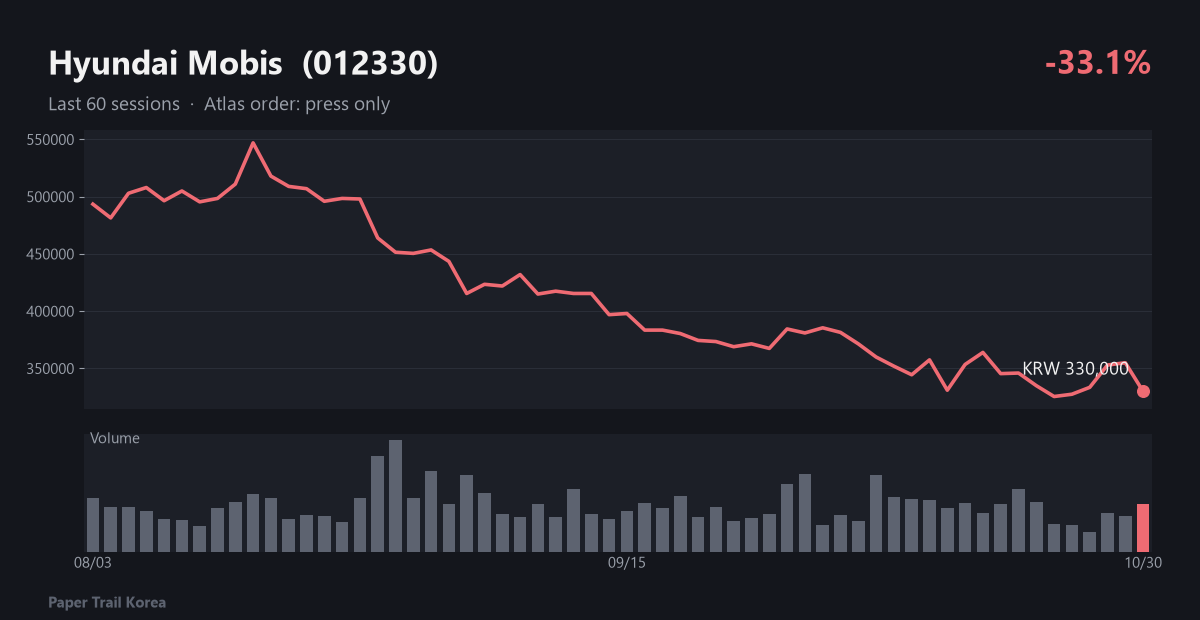
Electronic Times (Oct. 26) reported that Hyundai Mobis won all of the actuator order for Boston Dynamics' Atlas. Newsis reported that Mobis will expand into robotics parts. But the robot business sits on top of an auto-parts core, and our data does not show what share of revenue it is. The stock is down 33.1% from its Aug. 3 close and 39.7% below its period high. Recent filings are third-quarter preliminary results (fair disclosure), a treasury-share disposal decision, investor-relations notices, and a corrected company-split decision on Oct. 28. The titles alone do not show any link to robots, and no filing announces an order. Maeil Business reported that third-quarter operating profit rose 17%.
The research record has no confirm or deny signals for this stock, so we drew the checks from press reports. Watch whether Atlas deliveries show up as separate robot-parts revenue and whether production volumes become specific. The core business carries its own risks. SBS Biz reported that a defect in a battery part exclusively supplied by Mobis' Spanish plant briefly halted a Volkswagen factory, and the Spanish unit's head was replaced.
SBB Tech, a domestic reducer maker, but no confirmed orders
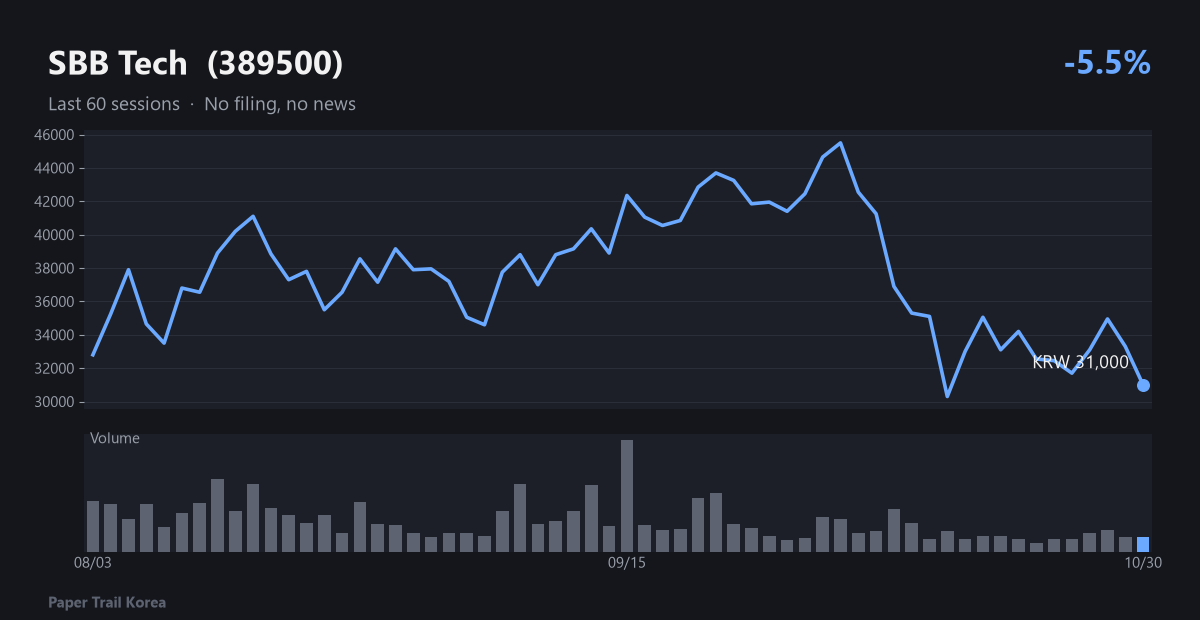
SBB Tech localized the harmonic reducer in 2013. A September 2025 report (finance-scope) said its product is about 30% cheaper than Japanese ones, its dedicated Cheonan plant was due to begin mass production in the second half, and a Taiwanese robot maker was testing it. The research record puts its market value at about $160 million, the smallest of the four. Confirmed orders or market share are not in the data. The stock is down 5.5% from its Aug. 3 close and 31.9% below its period high. There were no filings in the past week and no news in the past three days.
Watch for a supply-contract filing with the Taiwanese robot maker now testing the product, and for whether the Cheonan plant's output turns into reported revenue. If the test does not become a contract, being a reducer maker alone does not confirm a share of the bottleneck.
What to be careful about with this theme
- Making a bottleneck part is not the same as earning from it. Robotis and MP Materials are loss-making in our research record, and Hyundai Mobis' robot revenue is not separately confirmed.
- The firms holding the near-monopoly are overseas. Japanese, German and Swiss makers have led for 50 years or more, and our data has no evidence that a Korean listed firm holds a multi-year backlog. Hankyung reported that 87 of every 100 humanoids shipped worldwide in the first half were Chinese-made.
- Bottlenecks can ease or move. If China relaxes export controls, magnet prices could change. Memory, batteries and MLCCs (multilayer ceramic capacitors) are also candidates. Samsung Electro-Mechanics raised MLCC prices 30% this month and a robot uses about 10,000 of them, but its revenue is diversified, so this article does not cover it.
- The whole market fell. On Oct. 30, KOSPI was down 3.48%, KOSDAQ 3.83% and the Nasdaq 2.86%. Some of the moves in these stocks may reflect that.