Fusion Stocks? The Real Bottleneck Is HTS Superconducting Tape
One fusion power plant can need over 10,000 km of superconducting tape, and only about 10 companies make it. We checked how closely SuNAM and American Superconductor are tied to that bottleneck.
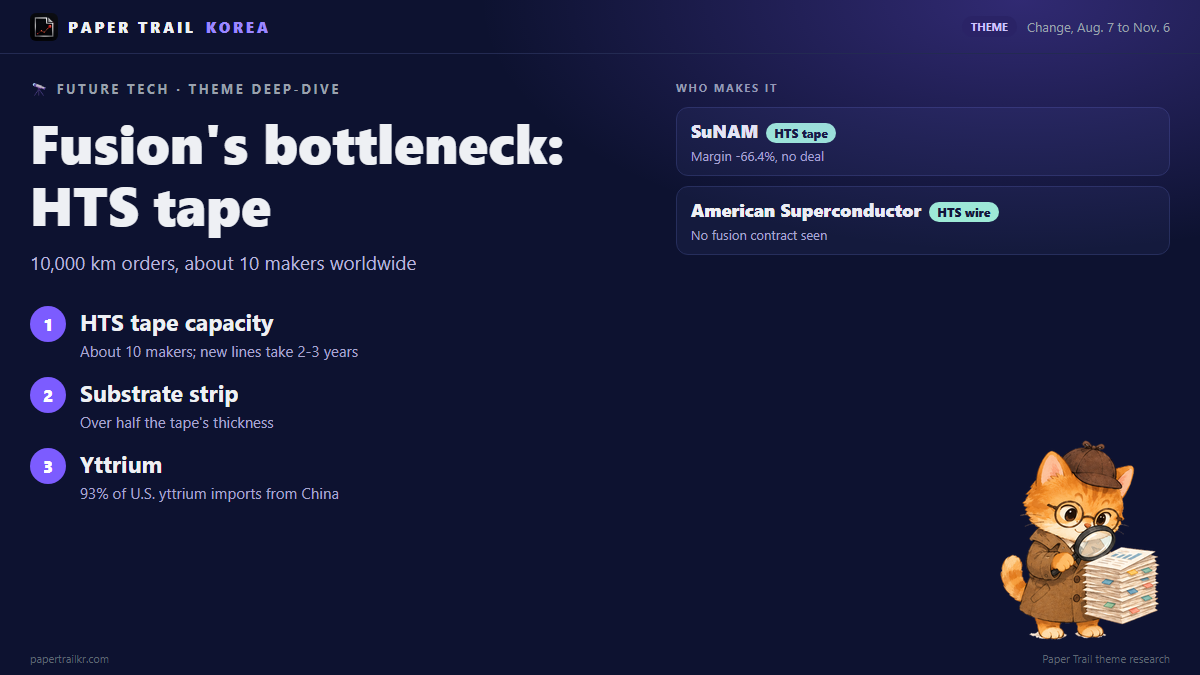
Seoul — The global market for high-temperature superconducting (HTS) tape is projected to grow from US$0.6–1.0 billion in 2026 to US$6.5–10.9 billion in 2038, a 22% annual rate, according to Meticulous Research. Fusion is already driving the growth in volume. The first thing likely to run short as fusion plants scale is the capacity to make that tape.
Paper Trail's own theme research (as of 2026-11-06 11:08 KST) found two listed companies that make this part: SuNAM in Korea and American Superconductor in the U.S. Neither has confirmed fusion revenue.
At a glance
| Stock | Bottleneck part | Nature of the news | Evidence | What to check next |
|---|---|---|---|---|
| SuNAM | HTS tape (2G coated conductor) | Expectation | Reports only | Narrower losses, large fusion order filing |
| American Superconductor (AMSC) | HTS tape (Amperium wire) | Expectation | Reports only | Confirmed fusion supply contract, operating margin |
Both stocks fell over the period studied (early August to November 6). The 'bottleneck part' column names what each company makes. It does not explain a price rise.
Bottleneck 1: HTS tape capacity
HTS tape is the raw material for the superconducting magnets that confine plasma in a tokamak (a doughnut-shaped fusion reactor). A thin ceramic superconducting layer is deposited on a narrow metal strip. Meticulous Research lists about 10 makers: Fujikura/SuperPower (Furukawa), Sumitomo, SuperOx, Shanghai Superconductor, SuNAM, THEVA, AMSC and Faraday Factory Japan, among others.
The deposition step is slow, so capacity is hard to add. According to Paper Trail's research notes, a new line of 1,000 km a year costs about US$50 million and takes 2–3 years. Russia's SuperOx, once a key supplier to CFS, is effectively out of the picture because of sanctions risk (commercial-fusion.com).
Demand rises in steps with each plant. CFS's SPARC demonstration reactor needs about 10,000 km (OilPrice). On September 30, 2026, CFS placed a single order with Fujikura for more than 10,000 km (3 GA-m) for its ARC power plants, the largest ever (Black Ridge Research). The UK's STEP prototype is estimated to need about 30,000 km (Tokamak Energy material).
Bottleneck 2: Nickel-alloy substrate
The tape is about 100 microns thick, and more than half of that is a nickel-alloy (Hastelloy-type) substrate of 50–75 microns. Few firms can roll it that thin and that precisely; VDM Metals and HPMetals are examples. If substrate supply lags, tape capacity stalls with it.
Substrate demand scales one-for-one with tape length: a tenfold rise in tape means a tenfold rise in substrate. The two listed companies here make tape, not substrate.
Bottleneck 3: Yttrium feedstock
The superconducting layer (REBCO) uses rare earths such as yttrium. The U.S. imports all of its yttrium, and 93% of it came from China in 2020–2023 (USGS data, via commercial-fusion.com). Almost no non-Chinese supply chain exists.
The coating on each meter of tape is only a few microns thick, so the amount per meter is small. If plants push tape demand into tens of thousands of kilometers, total feedstock demand rises at the same rate.
SuNAM: pure tape maker, but losses have deepened
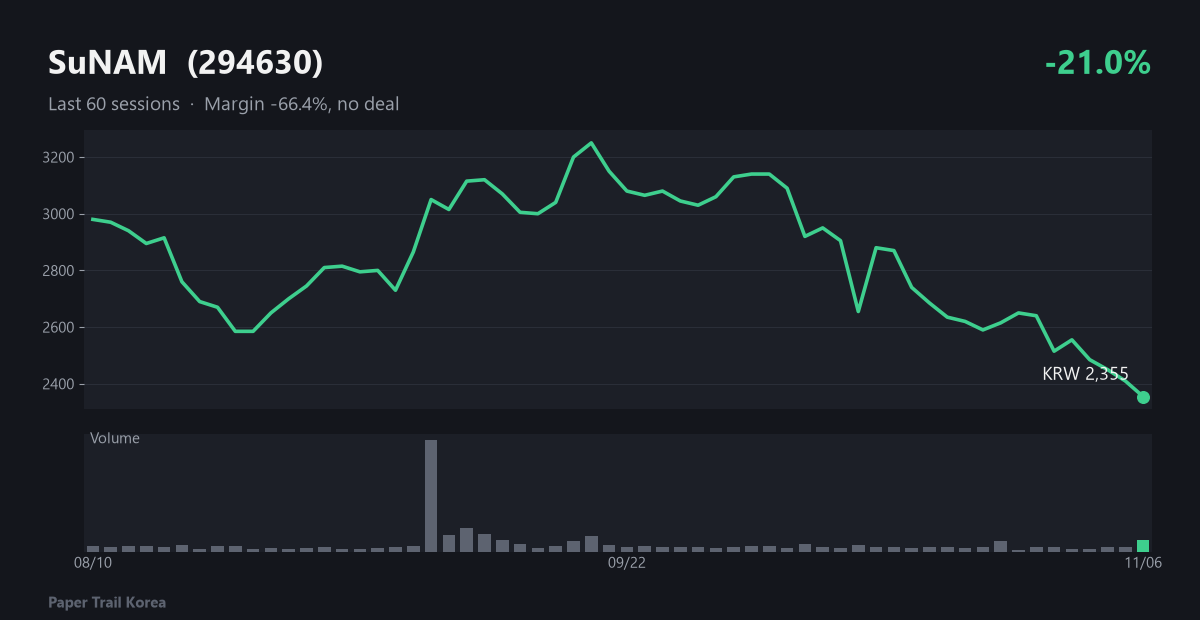
SuNAM, based in Anseong, Gyeonggi, was founded in 2004 (StockAnalysis profile). Paper Trail's notes say all of its revenue comes from superconducting wire, which makes it the purest tape play among the top 10 makers. Its market capitalization is about US$40 million. No confirmed supply contract with a fusion project such as CFS or STEP has been found.
Latest-quarter gross margin was -66.4%, down 29.8 percentage points from a year earlier, and net margin was -124.2% (Paper Trail research). The stock closed at 2,355 won on November 6, down 21.0% since August 10 and 27.5% below its period high of 3,250 won on September 18. A single-sale/supply contract disclosure was filed on October 26, but the counterparty, amount and any fusion link are not in the material we reviewed. There was no news in the last three days.
Two things to watch. First, whether gross-margin losses narrow; the research notes use a move from -66% to the -40% range as the marker. Second, whether a large order of thousands of kilometers from CFS, STEP or VEIR appears in a filing. Negative signs would be a gross margin worse than -70%, a rights offering or convertible bond that dilutes shareholders, or a big capacity expansion by overseas makers such as Fujikura or Sumitomo.
American Superconductor: no fusion contract in view yet
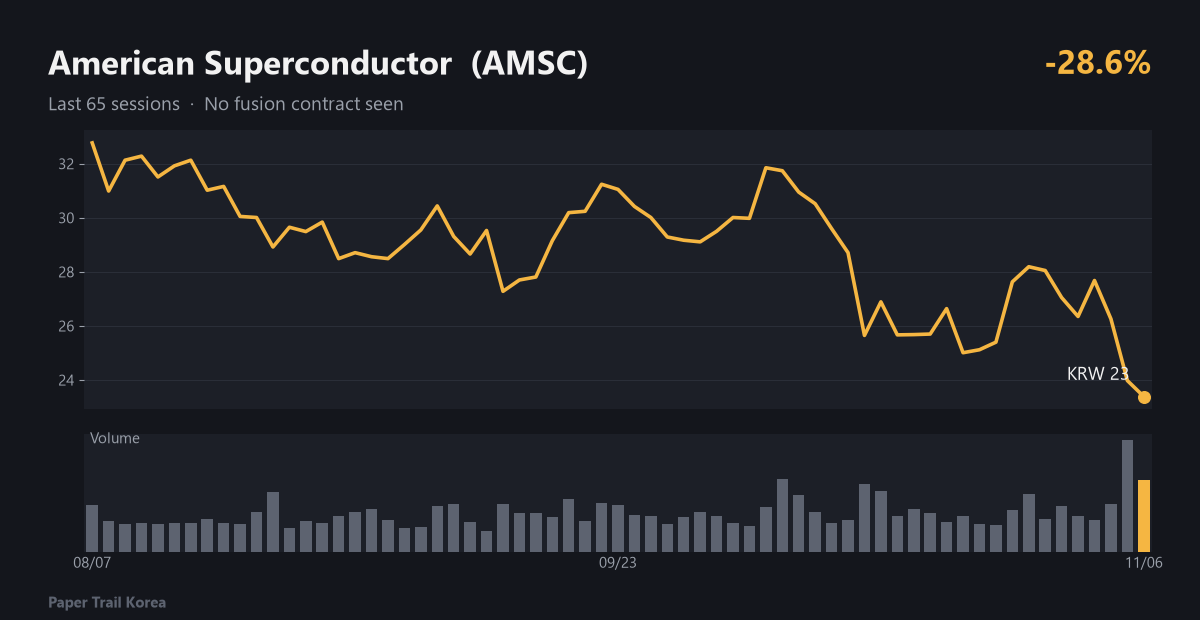
AMSC makes Amperium HTS wire (tape) and is listed in the U.S. Its market capitalization is about US$1.16 billion. Most revenue comes from power grid, wind and defense products. No confirmed fusion supply contract has been found, so it is hard to call it a pure fusion company. Latest-quarter gross margin was 28.2% (Paper Trail research).
On November 4 it reported results for its fiscal second quarter (ended September 30). Yahoo reported revenue of US$94 million, up from US$65.9 million, and orders above US$95 million, and also said project timing next quarter looked difficult. Recent filings were the 10-Q and an earnings 8-K; there was no fusion-related contract filing. The stock closed at US$23.39 on November 6, down 28.6% since August 7, and 24/7 Wall St. reported a 52-week low. In the research record, analysts made one upward and five downward revisions in the past 30 days.
Watch for a confirmed large supply contract with a fusion developer such as CFS or STEP, and for operating margin, now 2.6%; the research notes use 5% or more as the marker. If filings show fusion revenue to be negligible, or earnings estimates keep falling, the link to this theme weakens.
What to be careful about in this theme
- The largest order did not go to either company. CFS's 10,000 km-plus order went to Japan's Fujikura. No comparable fusion contract has been confirmed for SuNAM or AMSC. Who wins follow-on orders is the open question.
- Fusion revenue is small or mixed at both firms. AMSC is mostly grid, wind and defense. SuNAM sells only wire, but its fusion share is not confirmed by filings.
- Finances have to hold up first. SuNAM's losses are deepening and its free cash flow is negative. It may need new funding before demand arrives.
- The market size is one firm's estimate, and the market was weak. The 2038 figure comes from Meticulous Research alone. On November 6 the KOSPI closed down 6.02% and the KOSDAQ down 5.03%, so part of both stocks' declines may have nothing to do with this theme.