Quantum Computing Stocks: The Bottleneck Is Cryogenic Amplifiers
As quantum computers scale, the parts that read and cool qubits may run short before the qubits themselves. Here is what four listed companies actually make, and what is still unproven.
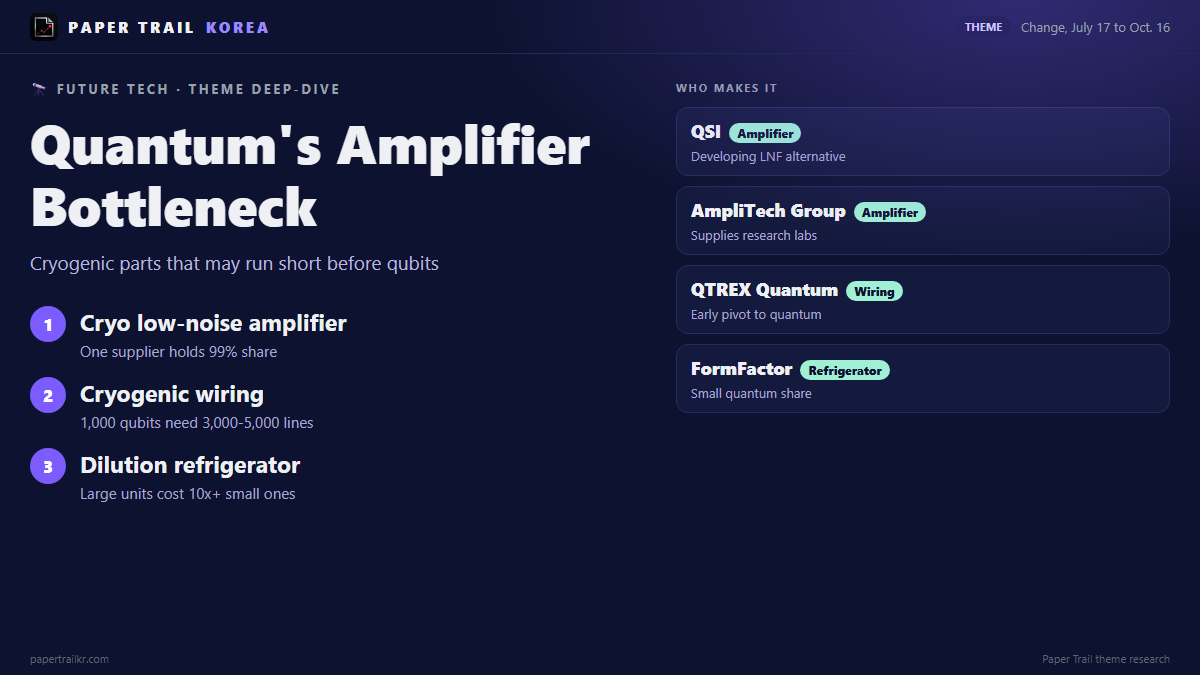
Seoul — The quantum computing market is projected to reach $5.41 billion in 2030 and $15.2 billion in 2035, according to The Quantum Insider's base-case estimate, which comes with a wide uncertainty range. Paper Trail's own theme research (as of 2026-10-18 11:21 KST) points to one part that may run short first: the cryogenic low-noise amplifier (Cryo-LNA) that boosts faint qubit signals. Korean press reports that Sweden's Low Noise Factory (LNF) holds 99% of the global market for these modules.
At a glance
| Company | Bottleneck part | Nature of the news | Evidence | What to check next |
|---|---|---|---|---|
| QSI (066310) | Cryo-LNA chip (MMIC) in development | Expectation | Press reports only | An LNF-replacement supply contract or mass-production order |
| AmpliTech Group (AMPG) | Cryogenic HEMT amplifiers | Expectation | Press reports only | New quantum-related orders in filings; any financing |
| QTREX Quantum (QTEX) | Cryogenic wiring and interconnects | Expectation | Press reports only | Actual revenue from wiring products |
| FormFactor (FORM) | Cryogenic wafer prober and benchtop dilution refrigerator | Expectation | None | Whether the Oct. 28 results mention quantum |
The second column shows the bottleneck part each company covers, not the reason for any price move. AmpliTech's stock fell sharply over the period.
Bottleneck 1: Cryogenic amplifiers, one supplier holds 99%
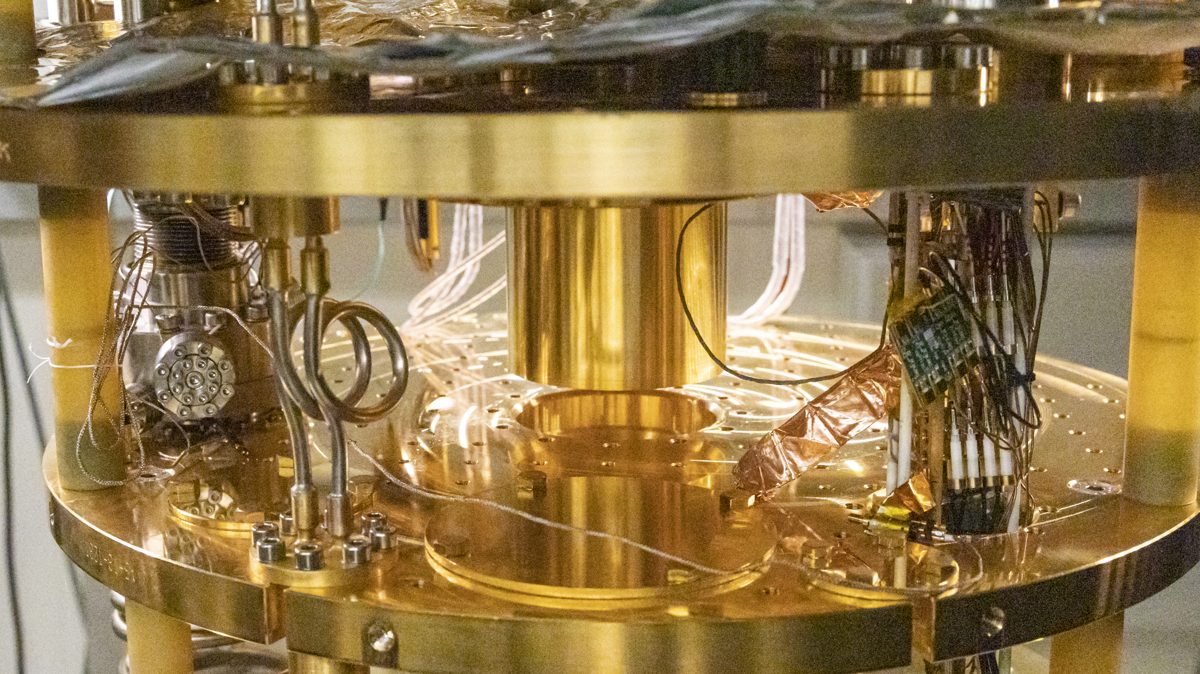
Qubit signals are extremely weak. They must be amplified near absolute zero without adding noise, or they cannot be read. Per Korean press (Etoday), LNF is effectively the only maker of these modules.
As qubit counts rise, so do the readout channels. The research notes say that even with frequency multiplexing (sharing one line among many signals), the amplification chain per channel does not shrink. With one dominant supplier, a jump in demand leaves few alternatives.
Bottleneck 2: Cryogenic wiring, 3,000 to 5,000 lines at 1,000 qubits
Special coaxial cables carry signals from room temperature down to millikelvin levels with little heat transfer. Seeqc says a 20-qubit system needs 80 to 120 wires, 100 qubits need 300 to 500, and 1,000 qubits need 3,000 to 5,000. That is roughly 3 to 6 lines per qubit.
Supply rests on a few unlisted makers, such as Delft Circuits and CryoCoax, producing in small volumes. The coldest stage of a refrigerator has only microwatts of cooling capacity, so extra wiring adds a heat load that becomes the limit (Seeqc).
Bottleneck 3: Dilution refrigerators and helium-3, price rises tenfold with size
Dilution refrigerators, which cool quantum chips to millikelvin temperatures, come from a handful of makers: Bluefors (Finland, 1,800+ units shipped), Oxford Instruments (UK) and Maybell Quantum (US). Per postquantum.com, high-end models have lead times of 6 to 12 months and are built to order, so capacity is hard to add quickly.
Cost per unit and helium-3 use climb steeply. A small LD450sl costs $700,000 to $1 million, while a large KIDE costs $5 million to $10 million. Small units use 5 to 12 liters of helium-3, and the large XLD1000sl uses about 40 liters. Postquantum.com puts annual ground supply at 22,000 to 30,000 liters against demand of 40,000 to 60,000 liters or more.
QSI: a possible alternative, but no contract yet
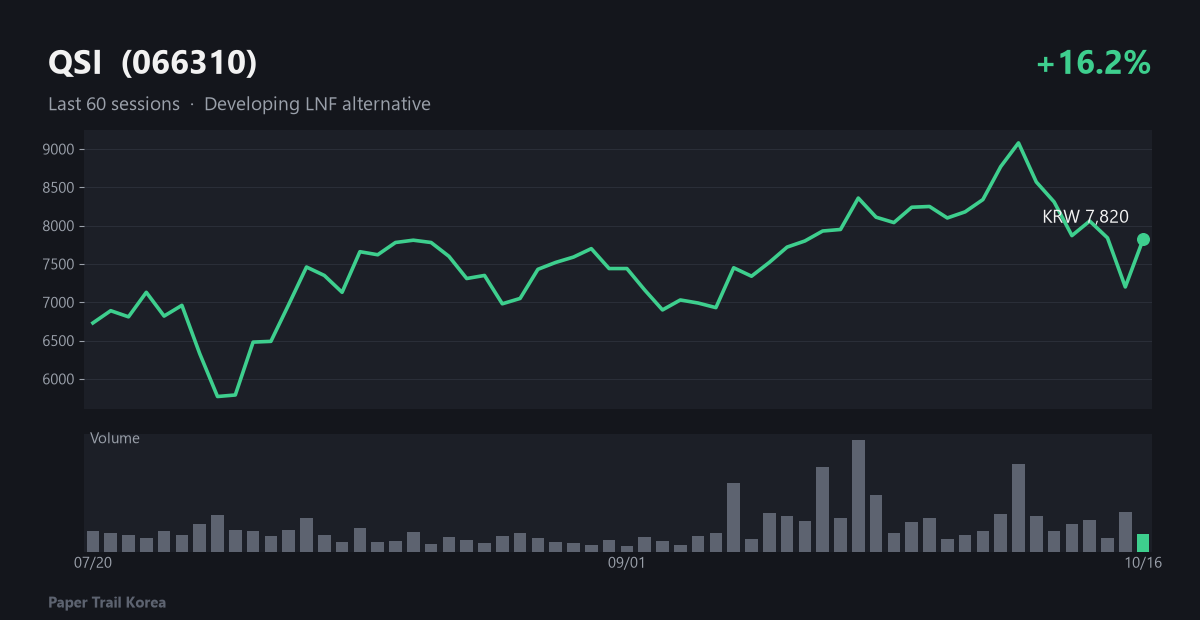
QSI is developing an InP HEMT-based (indium phosphide, high-frequency device) cryogenic amplifier chip under the Eurostars joint R&D program. Our research records a goal of shipping samples to quantum computer makers in 2026. Korean outlets reported that QSI supplied chip samples to quantum device developers, and one article described it as co-developing with LNF. But no mass-production contract or revenue contribution has been confirmed. There was no theme-related news in the last 30 days.
The stock is up 16.2% since July 20 and 13.9% below its high for the period. We found no disclosures or news in the last week. Two things matter next: whether an official LNF-replacement contract or production order is announced, and whether a Eurostars delay or failure, or a production-test quality problem, is reported. An LNF capacity expansion would further entrench its position.
AmpliTech Group: it supplies the parts, but the stock has fallen hard
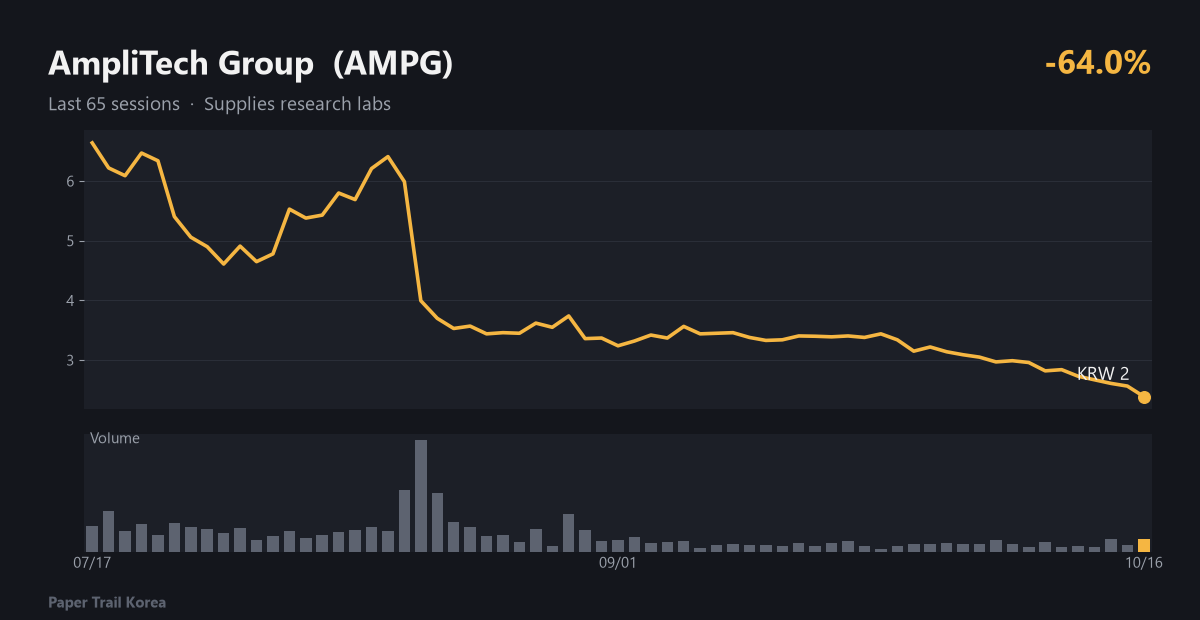
AmpliTech said it supplies low-noise HEMT amplifiers for 4K cryogenic environments to two Fortune 50 companies plus universities and research institutes (The Quantum Insider, December 2024). Its latest order news, though, is not about quantum. The $17 million-plus in third-quarter orders announced Oct. 14 relates to 5G Open RAN radio equipment. How much of its revenue comes from quantum amplifiers is not clear from the data we have.
The stock is down 64.0% since July 17, and the same 64.0% below its high for the period. The data does not explain the decline. The last week's filings were a proxy statement (DEF 14A) and ownership reports (Schedule 13G). Second-quarter revenue was $8.07 million, up 50.9% from the prior quarter (finviz summary). Our research also notes trailing revenue down 26.8% year on year and two analyst estimate cuts. Next to check: a large new quantum-related order in a filing, and a recovery in gross margin. Any equity financing is also worth tracking.
QTREX Quantum: a wiring design is out, but revenue is unproven
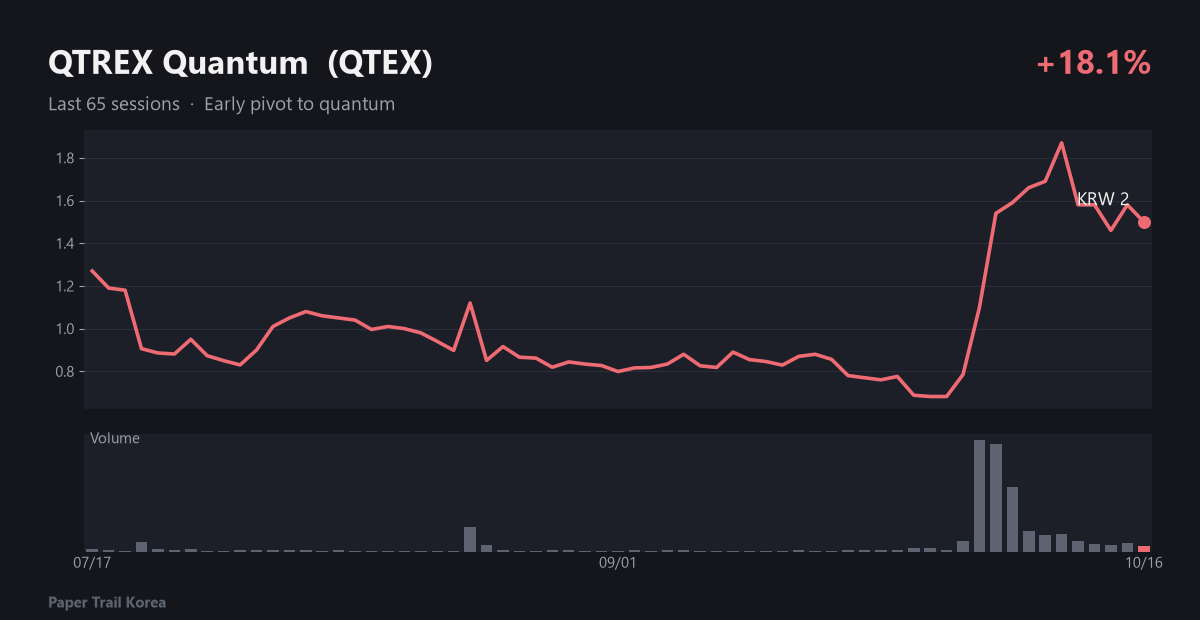
Formerly Inspira Technologies, a medical-device company, it has pivoted to quantum. It says it is developing an architecture with up to 17,280 coaxial lines per refrigerator stage (The Quantum Insider, May 2026) and in October unveiled an ultra-high-density quantum interconnect design. Our research judges the pivot to be at an early stage, with an uncertain revenue base.
The stock is up 18.1% since July 17 but 19.8% below its high for the period. It ran from $0.682 on Sept. 30 to $1.87 on Oct. 9, then pulled back. The last week's filings include one Form 6-K and three insider reports on Form 4. Director Tal Parnes reportedly bought 6,666 shares at $1.50, and the company said it has no investor warrants or ATM program. Next to check: whether the wiring products turn into customer orders and revenue.
FormFactor: a chip-test equipment maker with a small quantum share
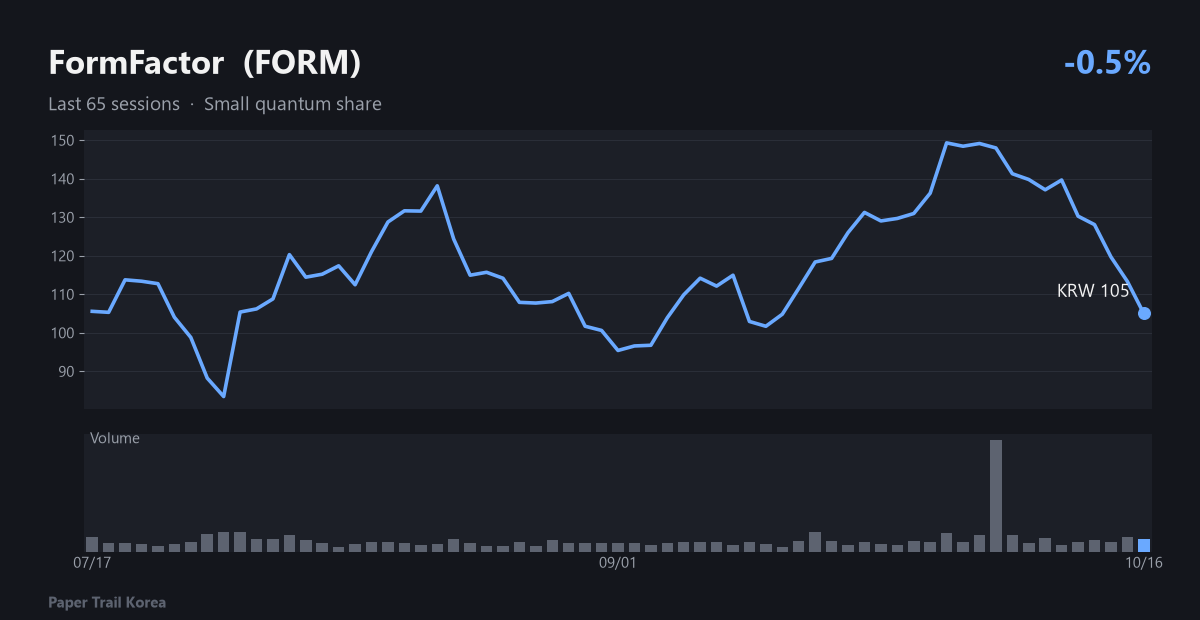
FormFactor sells the IQ3000 4K fully automatic cryogenic wafer prober (a chip-testing tool) and the Flatiron millikelvin benchtop dilution refrigerator, per its product page. But semiconductor test equipment is its core business, and our research judges the quantum share of revenue to be small. We found no confirmed orders or market-share figures.
The stock is down 0.5% since July 17 and 29.7% below its high for the period. The Oct. 13 8-K covers a private placement of 2,234,887 shares to Teradyne for about $300 million. It has nothing to do with quantum. News also reported a CEO stock sale of about $1.39 million. Next to check: whether the Oct. 28 earnings call singles out the quantum business.
What to watch out for in this theme
- Few pure plays exist. All four companies have small, absent or mixed quantum revenue. Even if the bottleneck is real, there is no guarantee the benefit reaches these firms.
- The market forecast itself is uncertain. The $5.41 billion figure for 2030 is The Quantum Insider's base case within a range.
- A helium-3 shock may be limited in the near term. An expert analysis (investmentmonitor.ai) says superconducting quantum computers' helium-3 supply chain is separate and dry dilution refrigerators are spreading.
- Funding and survival risk is large. Our notes track SensorView (321370) only as a watch name. It has a 22 billion won order backlog, more than double a year earlier (Money Today), but also a 138% debt ratio and a -98.3% net margin. AmpliTech also faces falling revenue and lower estimates.
- The broader market is shaky. The Nasdaq fell 2.15% on Oct. 16 on high-rate and inflation worries, and FormFactor fell 7.35% the same day.