After GPUs, the Shortage Is MLCC Capacitors and Transformers
One AI server holds about 28,000 MLCCs, and large transformers can take 3 to 5 years to deliver. We looked at the parts that run short first and the four listed companies that make them.
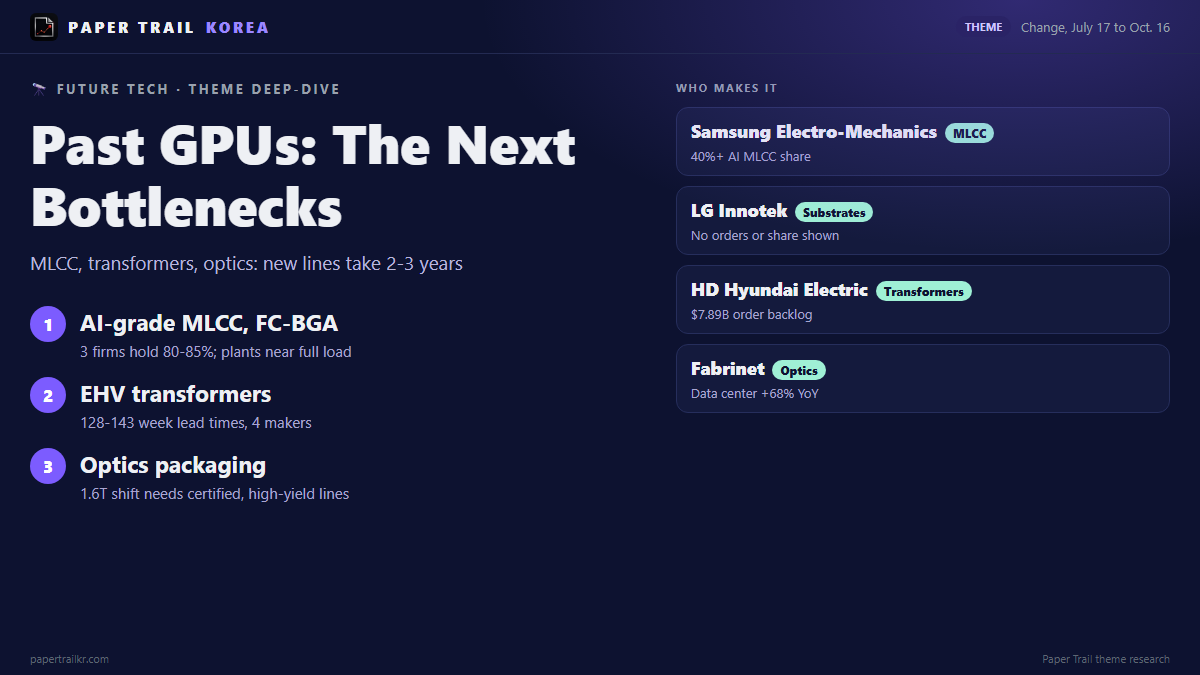
Seoul — The market for AI-server MLCCs (multilayer ceramic capacitors, tiny parts that keep power steady on a board) is set to grow from $1.4 billion in 2025 to $5.8 billion in 2030, Goldman Sachs estimates, a 34% compound annual rate (via Edaily). As AI spending moves past the GPU to the rest of the server, the first thing to run short is a part like this. According to Paper Trail's own theme research (researched 2026-10-17 11:09 KST), the first shortage is high-capacity MLCCs and the package substrates that go with them.
| Company | Bottleneck part | Nature of the news | Evidence | What to check next |
|---|---|---|---|---|
| Samsung Electro-Mechanics | AI-server MLCC, FC-BGA substrates | Substance, durable | Filings exist (AI link unconfirmed) | AI-server share and profitability in Q3 results |
| LG Innotek | FC-BGA substrates | Expectation | None | FC-BGA revenue share, expansion or order filings |
| HD Hyundai Electric | Extra-high-voltage transformers | Substance, durable | Press reports only | Q3 results around Oct. 22, new orders |
| Fabrinet | Precision packaging for AI optical transceivers | Substance, durable | Press reports only | Whether data-center revenue growth holds |
All four stocks are lower than in mid-July. KOSPI fell 7.57% on Oct. 15 alone (Hankyung Business), and every price below comes after that shock. The 'Bottleneck part' column describes what each company makes, not the direction of its share price.
Bottleneck 1: High-capacity MLCCs and FC-BGA substrates take 2–3 years to add
Three companies, Murata, Samsung Electro-Mechanics and Taiyo Yuden, hold 80–85% of AI-grade MLCCs (passive-components.eu). Utilization is in the high 90s percent, close to full. A new line takes 2 to 3 years to reach production, so extra demand cannot be met quickly.
An AI server holds about 28,000 MLCCs, more than 10 times a standard server. Lead times on high-capacity parts run 20 to 26 weeks and up to 40, and spot prices are up 50–60%. FC-BGA (a high-end substrate that connects a chip to a board) is also made by few firms: Ibiden, Unimicron, Samsung Electro-Mechanics and LG Innotek. Samsung Electro-Mechanics president Chang Duck-hyun said demand for server and data-center FC-BGA exceeds capacity by more than 50% (Herald Business).
Bottleneck 2: Extra-high-voltage transformers, a 3-to-5-year wait
Only a handful of firms build large transformers: HD Hyundai Electric, GE Vernova, Siemens Energy and Hitachi Energy. Average lead times are 128 to 143 weeks (2.5 to 3 years), and large units take 3 to 5 years. Wood Mackenzie estimates U.S. transformer demand rose 41–116% between 2019 and 2025.
Data centers pull more power, so they need more transformers. Morgan Stanley sees a 32 GW shortfall (34% of demand) in U.S. data-center power from 2026 to 2028, and a total gap of up to 57 GW.
Bottleneck 3: Optical transceiver packaging, where certification and yield are the gate
Optical transceivers convert electrical signals to light so servers can exchange data. Speeds are moving from 800G to 1.6T. The suppliers with the precision packaging and lasers for that step are limited to Coherent, Lumentum, Fabrinet and a few others, and certification and yield take time. Nvidia's $2 billion direct investments in each of Coherent and Lumentum are read as an effort to secure capacity.
As GPU clusters grow to hundreds of thousands of chips, the number of optical links per node rises faster than the chip count. Interconnect becomes the new bottleneck.
Samsung Electro-Mechanics: high MLCC share, but the AI portion has to be separated out
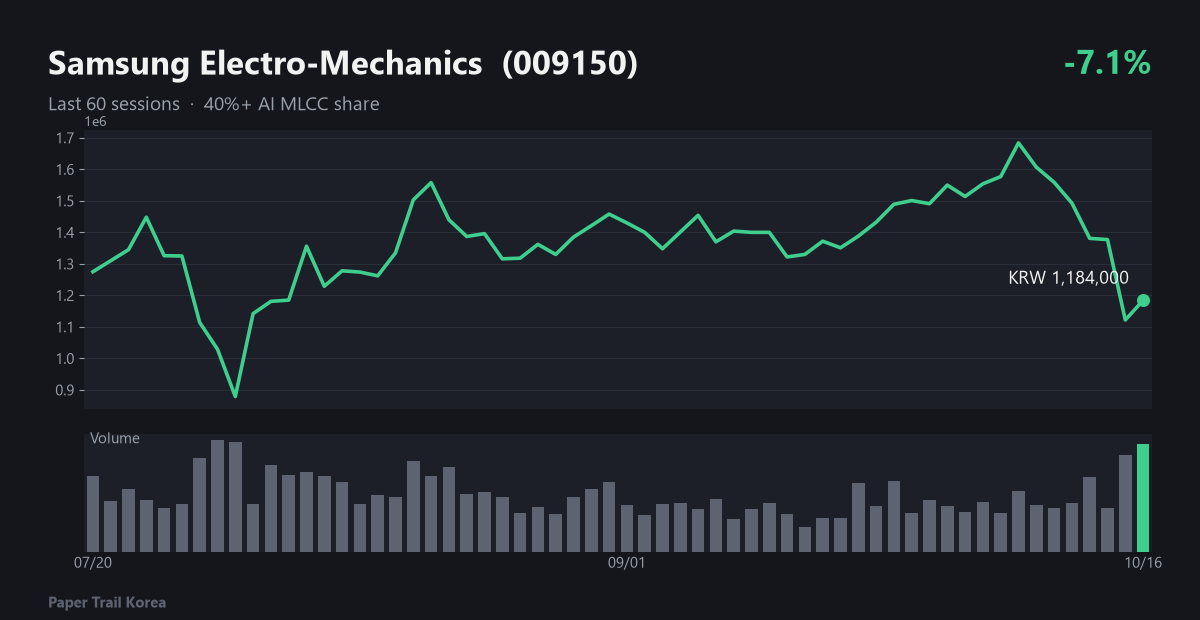
Samsung Electro-Mechanics holds more than 40% of AI-server MLCCs (Edaily). Daishin Securities projects 2026 FC-BGA revenue of 1.7 trillion won, up 45.5% from a year earlier. But the company also makes parts for smartphones and other devices, and the data here does not give the AI-server share of total sales. Hankyung reported that weak smartphone and IT demand has pushed the stock to about half its June peak of 2,417,000 won. It is down 7.1% since July 20 and 29.7% below its period high.
Over the past month it filed two supply-contract disclosures (Sept. 29 and Oct. 6) and a tangible-asset acquisition by a subsidiary (Sept. 28). The data does not show who the counterparty is or whether the products are for AI servers. Next to watch is Q3 earnings (the pre-announcement notice came Oct. 12). One report says revenue is growing but profitability differs across the two companies (Newsis). Added capacity that eases supply is a counter-signal. Herald Business reported exclusively that the company is weighing about 1.78 trillion won for FC-BGA in Vietnam.
LG Innotek: it makes FC-BGA, but the theme numbers are still blank
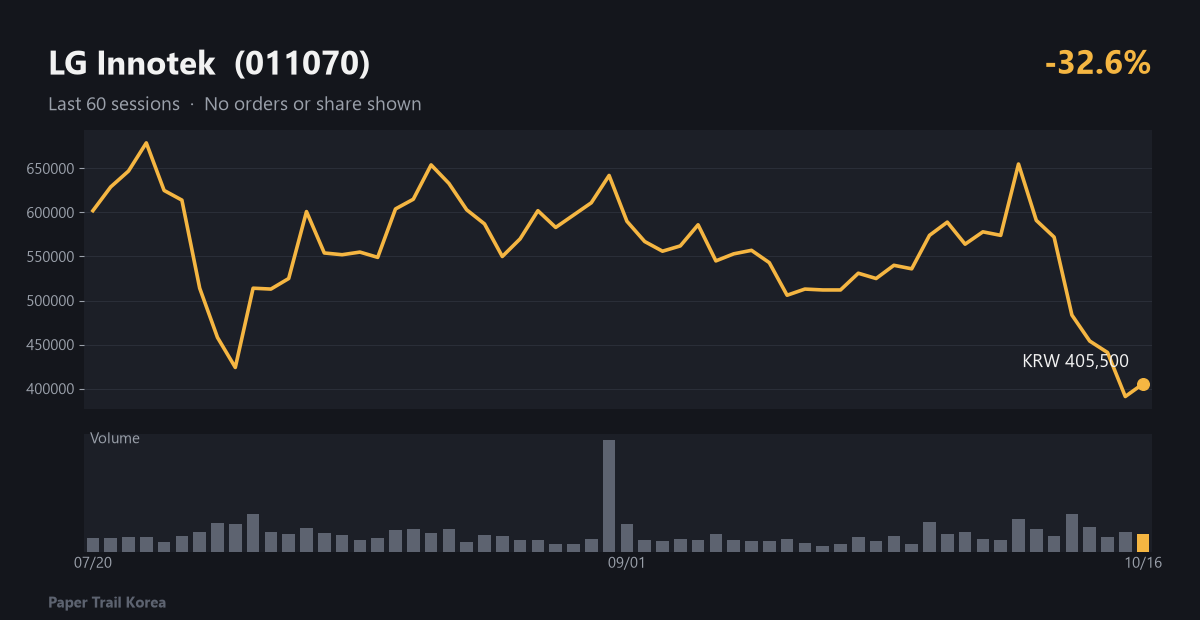
LG Innotek is one of the few FC-BGA substrate makers. The data here has no FC-BGA revenue, market share or confirmed orders for it. Newsis expects double-digit Q3 revenue growth but says profitability is different from Samsung Electro-Mechanics. Other businesses, including parts for the new iPhone, are mixed in, so the theme alone does not explain its results. The stock is down 32.6% since July 20 and 40.3% below its period high.
There was no filing directly tied to this theme in the past month. The disclosures were an investor-relations briefing notice (Sept. 18), an earnings pre-announcement (Oct. 2), and exchange notices on widened price limits for stock futures and options. Next to check: whether Q3 results break out FC-BGA's share and utilization, and whether an expansion or new-customer filing appears. If non-FC-BGA businesses stay large, the distance from the theme stays the same.
HD Hyundai Electric: orders are stacked up, but Q3 numbers come first
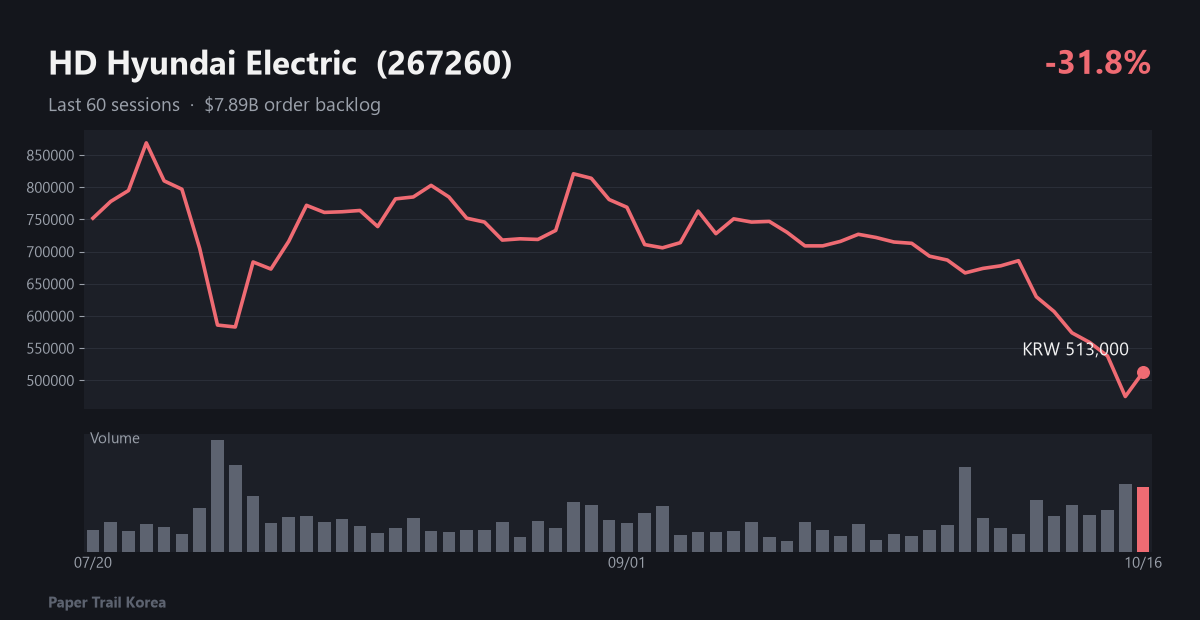
HD Hyundai Electric is described as the No. 1 transformer maker in North America (Daum report). It raised its 2026 order target from $4.22 billion to $5.185 billion (+22.8%) and had a first-quarter order backlog of $7.89 billion. On Oct. 15 it agreed to work with LG CNS on data-center power infrastructure and smart factories (NoCut News). Transformers are its core business, so it is the closest of the four to the theme. The stock is down 31.8% since July 20 and 41.0% below its period high.
There was no filing related to this theme in the past month. The disclosures were an IR briefing notice (Sept. 30) and an Oct. 15 exchange notice that price limits on its stock futures and options had widened after a decline. Next to check is Q3 earnings around Oct. 22, especially how the stronger won affects results. Gross margin is 33.6%, 1.2 percentage points lower than the prior quarter. A new large order or a further order-target increase would show the order flow continuing. A big operating-profit miss, or capacity expansion or price competition from GE Vernova or Siemens Energy, would point the other way. Hankyung says other large Korean transformer makers are also exporting more to the U.S.
Fabrinet: half its revenue is data centers, but it is a thin-margin contract manufacturer
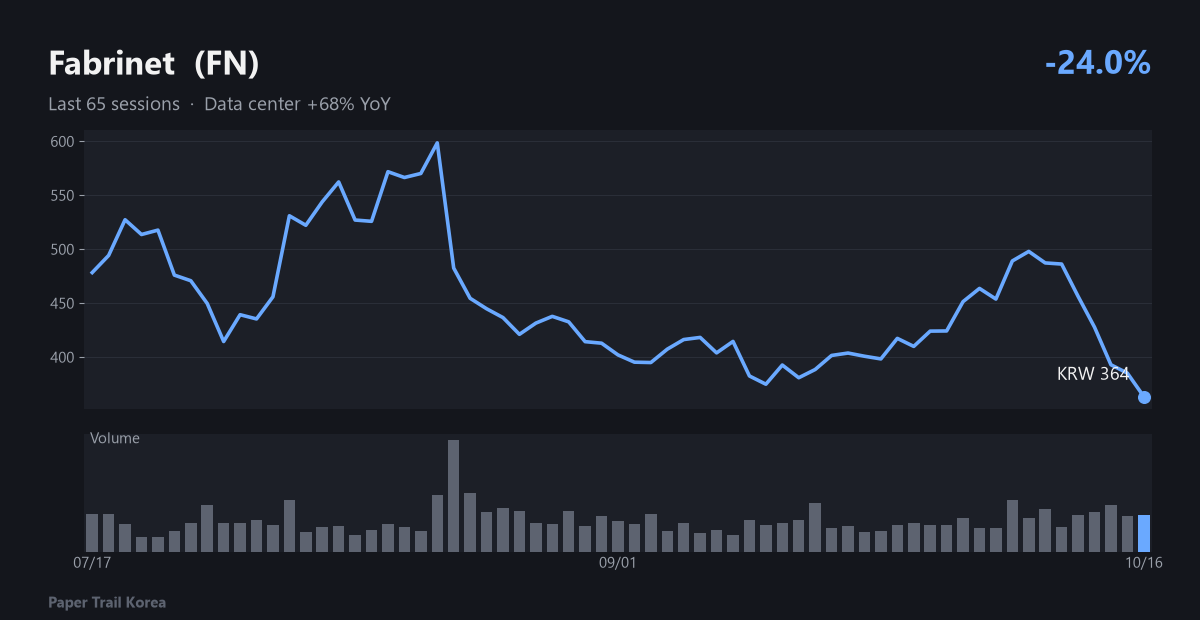
Fabrinet is a contract manufacturer (OEM) of optical transceivers and similar parts, and Zacks (via Chartmill) names it a key Nvidia production partner. Data-center revenue is $669 million, up 68% from a year earlier and 51% of total sales, which means the other half comes from other businesses. Gross margin is 12.0%, and Kalkine noted weak free cash flow despite record quarterly revenue. The stock is down 24.0% since July 17 and 39.3% below its period high, at $363.51.
No SEC filing tied to this theme appeared in the past seven days. Two things to check next: whether data-center revenue growth stays near 68% in the next report, and whether Nvidia places further 1.6T optical-module orders or announces added capacity. Share loss to Coherent and Lumentum expansion, or Nvidia moving packaging in-house, would be counter-signals.
What to be careful about in this theme
- Capital may be the bottleneck. The CEOs of Broadcom and Intel have both said capital, not memory chips, is the biggest hurdle to AI growth (The Star). Hankyung Business said U.S. inflation fears and credit risk at AI infrastructure companies drove the Oct. 15 KOSPI plunge. If funding tightens, parts orders can slow.
- New capacity can ease the shortage. Samsung Electro-Mechanics is weighing a Vietnam FC-BGA plant, and rivals in transformers could add capacity too. Once new lines run, price increases and long-term contract terms can weaken.
- Each company's theme revenue is mixed. Samsung Electro-Mechanics and LG Innotek have large smartphone and other component sales, and half of Fabrinet's revenue is outside data centers. Hankyung linked Samsung Electro-Mechanics' slide to weak demand for smartphones and other devices.
- Factors outside the theme drive the price. KOSPI is down more than 39% from its June high (Sisa Journal). All four stocks sit 29.7% to 41.0% below their period highs, and the cause may have little to do with these bottlenecks. This article does not cover SK Hynix, Micron, Coherent or Powell Industries. Our research notes held Coherent back because its business is diversified, even though Nvidia's investment makes its supply-constraint story strong.