Data Center Fuel Cell Stocks? The Real Bottleneck Is Scandium Oxide
As data center fuel cells scale, the first input to run short is scandium oxide, a market of 60–80 tonnes a year. We checked what four listed companies actually have on it.
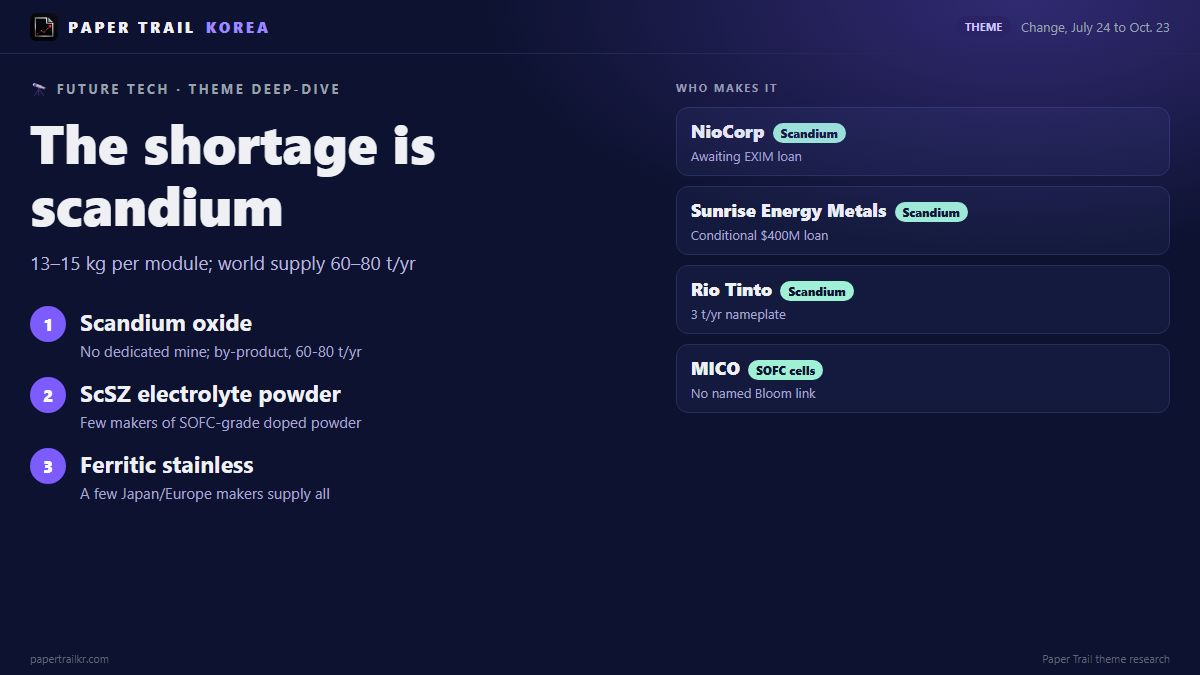
Seoul — Rystad Energy estimates that data center solid oxide fuel cell (SOFC) revenue will grow from $2.8 billion in 2025 to $30 billion in 2030. Paper Trail Korea's own theme research (as of 2026-10-24 11:06 KST) finds that the first input likely to run short is scandium oxide, because world output is only 60–80 tonnes a year.
At a glance
| Company | Bottleneck part | Nature of the news | Evidence | What to check next |
|---|---|---|---|---|
| NioCorp (NB) | Scandium oxide (planned Elk Creek mine) | Expectation | Filing | EXIM loan approval, construction funding |
| Sunrise Energy Metals (SREMF) | Scandium oxide (planned Syerston mine) | Expectation | Press reports only | Final loan terms, Nasdaq listing |
| Rio Tinto (RIO) | Scandium oxide (Sorel-Tracy, Quebec) | Substance, durable | Press reports only | Any expansion decision |
| MICO (059090) | SOFC cells and stacks; electrolyte candidate | Expectation | None | Whether it is named as an electrolyte supplier |
Over the period from July 24 to October 23, three of the four fell. Only MICO rose. Figures are below.
Bottleneck 1: Scandium oxide
There are almost no dedicated scandium mines. The metal is recovered only as a by-product of processing titanium, nickel, cobalt and uranium. Our research note cites USGS data putting 2025 consumption at 60 tonnes, up 50% from a year earlier. It also says China controls 85–90% or more of refined scandium and keeps an export licensing regime.
Demand per unit comes from Bloom Energy's own material: 13–15 kg of scandium oxide per 100 kW module. The oxide is a dopant in the cell's electrolyte (the ceramic layer that carries ions), has no substitute, and scales almost one-for-one with output. Rystad says a 2 GW expansion would bring required volume close to world supply of 60 tonnes a year.
New supply is slow. Sunrise's Syerston, the first dedicated mine, is planned to reach commercial production in the second half of 2028. NioCorp's Elk Creek still has a $1.4 billion funding gap. Our note puts new supply at two to four years at minimum; another source (Live in the Future) says five to eight years for a new primary mine.
Bottleneck 2: Scandia-stabilized zirconia electrolyte powder
Zirconia itself is plentiful, with more than 1.2 million tonnes a year processed. The hard part is doping it evenly with scandium to SOFC grade, which requires control of sintering (firing powder into a solid) and phase changes. Few companies have the equipment and process.
Bloom announced in 2024 that it would localize electrolyte material in South Korea, with supply to start in 2025. It did not name the manufacturer, and timing and volume are unconfirmed. Powder demand rises with the number of stacked cells, roughly one-for-one with capacity until a lower-temperature material is commercialized.
Bottleneck 3: Ferritic stainless steel for interconnects
Interconnects are metal plates linking cells, and at about 800°C they need an alloy whose surface oxide stays stable, such as the Crofer family. Per our note, a handful of makers, including ThyssenKrupp VDM (Crofer22) and Hitachi/Proterial (ZMG232), produce nearly all of it, and all are listed in Japan or Europe. One plate goes in per cell layer, so demand scales with capacity, but there is more room for alternative suppliers than with scandium. None of the four companies below makes this part.
NioCorp: A sales framework exists, but the mine is not funded
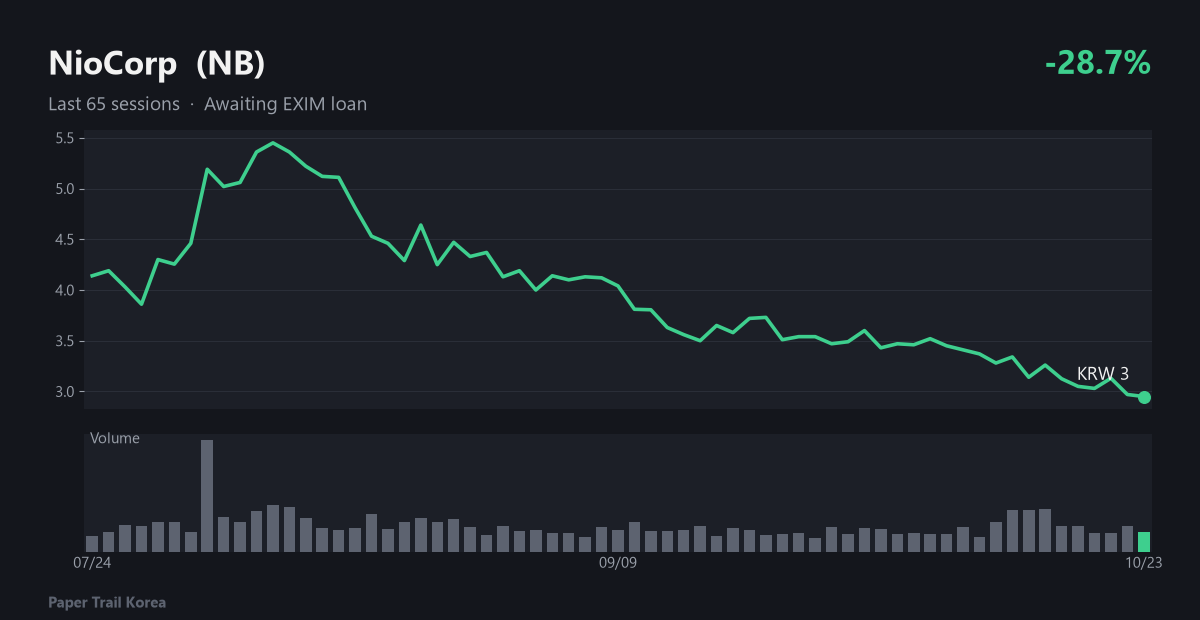
NioCorp plans to mine niobium, scandium and rare earths at Elk Creek in Nebraska. Paper Trail research finds it has almost no other revenue source, so the company and the scandium plan largely overlap. It signed a memorandum of understanding with Lockheed Martin for 15 tonnes of scandium oxide a year over 10 years. An 8-K filed on October 16 describes a new offtake agreement with Traxys. Traxys will buy 50% of annual ferroniobium output, or 3,700 tonnes a year at its election, on a take-or-pay basis. For scandium oxide and other products, Traxys gets the exclusive right to market them but no obligation to do so. A preliminary quarterly results update was filed the same day. The shares are down 28.7% since July 24 and 45.9% below the period high.
The next thing to check is funding. According to its 10-Q, NioCorp is still waiting for approval of a $780 million EXIM loan and cannot start construction before final financing. Our note says $1.4 billion of the $1.85 billion total is still unfunded. A delayed approval pushes back scandium supply with it.
Sunrise Energy Metals: Financing is opening, production is not before late 2028
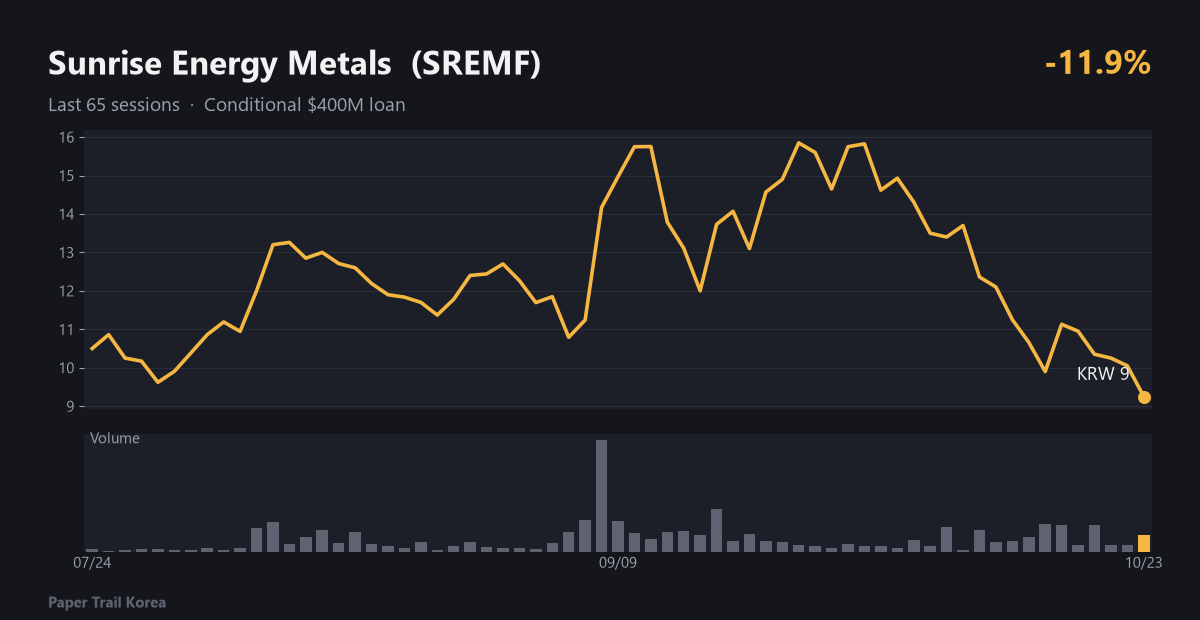
Sunrise holds the Syerston project in Australia, which our note describes as the world's first dedicated scandium mine, with reserves of 1,311 tonnes or more. It puts C1 cash cost at $534/kg and plans 60 tonnes a year in the second half of 2028. Kalkine reported that the company received a conditional US$400 million commitment from the Pentagon's Office of Strategic Capital for Syerston. Our note adds a $67 million EXIM letter of interest. The company has no scandium revenue yet. Shares are down 11.9% over the period and 41.6% below the high. International Business Times Australia reported a 15% drop as the company plans to move its listing to Nasdaq. No new SEC filing appeared in the past seven days.
Two things to watch: whether the conditional commitment becomes a final loan, and whether the Nasdaq listing completes. Until it does, access for U.S. investors is limited. A slip in the 2028 timeline would extend the shortage, but it would also delay the company's own revenue.
Rio Tinto: It already makes scandium, but as a small slice of a large company
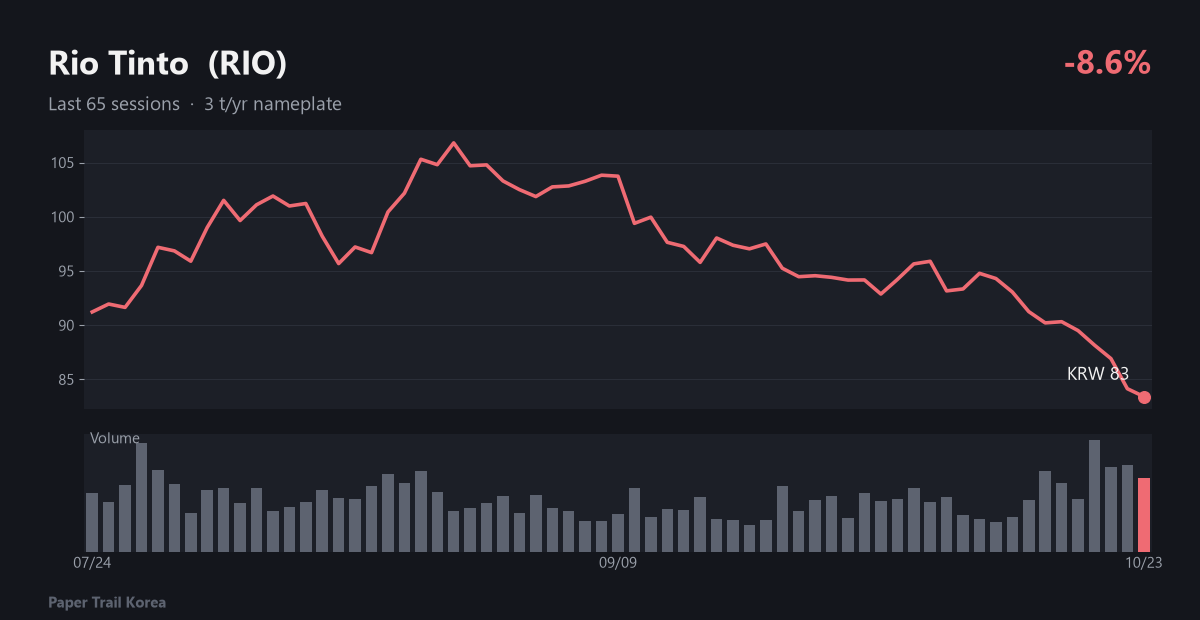
Rio Tinto has run a scandium demonstration plant at Sorel-Tracy, Quebec, since 2022. Mining.com and others report a nameplate capacity of 3 tonnes a year and an expansion under study. According to MWI West Point, its contract with the U.S. Defense Logistics Agency is priced at $6,250/kg, versus a market price of $640/kg. But Rio Tinto is a $135.67 billion miner, and scandium is a negligible part of its revenue. Its share price mostly follows its core businesses. A report on October 23 of a $1.9 billion investment in Queensland bauxite has nothing to do with scandium. The shares are down 8.6% over the period and 21.9% below the high. Two 6-K filings came on October 1 and 14, but the data does not show their contents, so any link to this theme is unconfirmed.
The next thing to check is whether an expansion at Sorel-Tracy is decided. Without one, the company does little to ease the bottleneck, and 3 tonnes is small against world output of roughly 60 tonnes a year.
MICO: It makes SOFC cells, but no link to scandium electrolyte supply yet
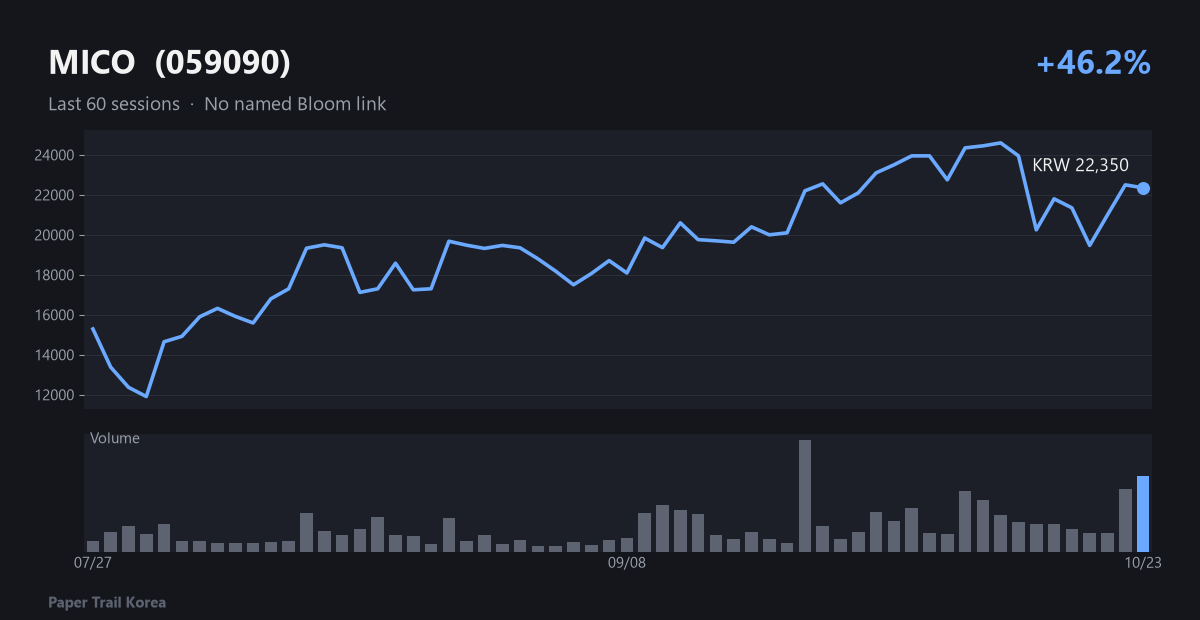
MICO is a Korean maker of SOFC cells and stacks. It completed a 1 MW-class production line in 2019, and a DB Financial Investment report says its TUCY product was certified at 51.3% power generation efficiency. Our note treats it as a candidate for Bloom's Korean electrolyte localization, but Bloom has not named its supplier, so the link is unconfirmed. A cell maker uses scandium rather than supplying it, so MICO does not directly relieve the bottleneck. The shares are up 46.2% since July 27 and 9.1% below the period high. Nothing in the data ties that rise to scandium. Bloter has written about MICO's acquisition of Nem Energy and its heat recovery steam generator (HRSG, equipment that makes steam from gas turbine exhaust heat) business. There has been no filing related to this theme in the past month. The one filing, on September 30, was a corrected disclosure of a share pledge contract involving a change of largest shareholder.
The next thing to check is whether MICO or Bloom states an electrolyte supply relationship. Until then, the link between this stock and the scandium bottleneck stays a possibility.
What to be careful about in this theme
Demand estimates conflict. Bloom says it sources scandium from multiple countries and suppliers and can support 25 GW a year, but that claim is not independently verified. The short seller Hunterbrook argues that a 5 GW target needs about 220 tonnes of scandium oxide, close to world supply of about 240 tonnes. Bloom told the SEC the claim is false. Rystad's figure of about 60 tonnes for 2 GW implies a very different per-GW need.
The pace of new supply matters. Sunrise's late-2028 production is a plan, and NioCorp's construction funding is not secured. If new mines arrive sooner than expected, the shortage is shorter.
Demand is concentrated in one customer. CRUX Investor says Bloom accounts for about 74% of world scandium consumption, and the 9 GW backlog in our note is effectively Bloom's. If Bloom's expansion slows, the bottleneck thins.
The companies' scandium revenue is small or absent. NioCorp and Sunrise are pre-production, scandium is a small part of Rio Tinto, and MICO has no confirmed link. Three of the four fell over the past three months, which shows that even if the bottleneck is real, each company's funding and timeline can decide the outcome.