Green Hydrogen Stocks? The Real Bottleneck Is Iridium, Not the Electrolyzer
As PEM electrolyzers scale, iridium, a by-product of platinum mining, runs short first. We checked how close four U.S.-listed companies really are to that bottleneck, and what argues against the theme.
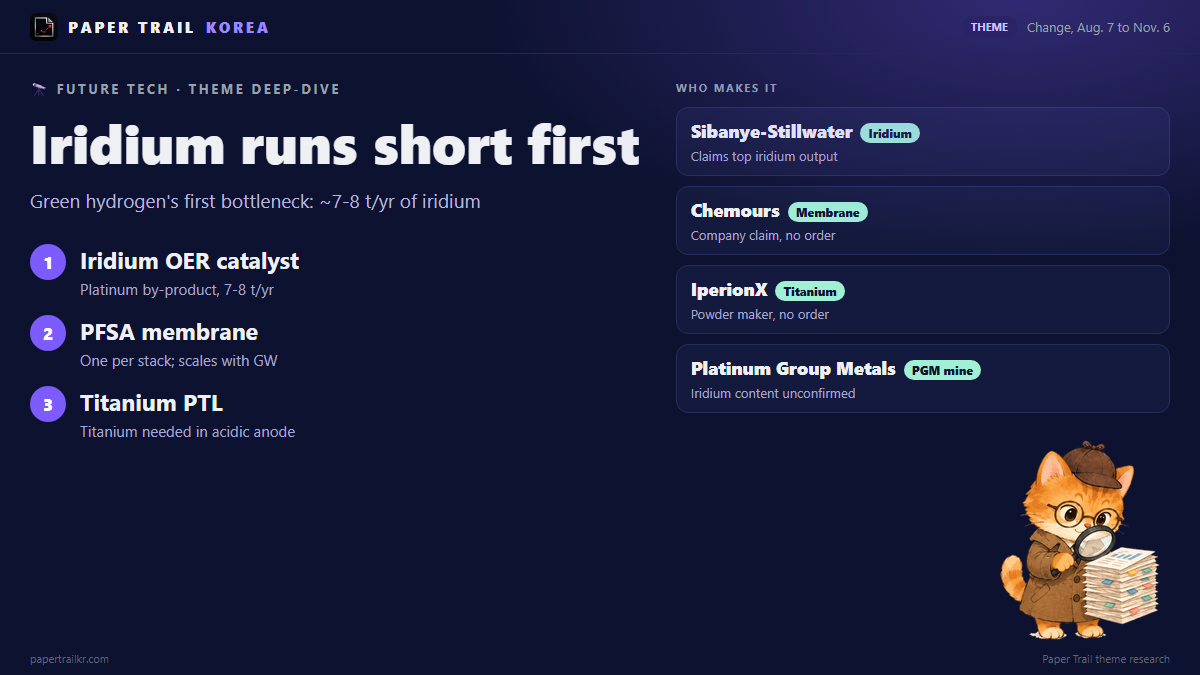
Seoul — GMI Insights estimates the market for PEM (proton exchange membrane) electrolyzer catalyst materials will reach about $1.7 billion by 2035, growing 25.3% a year. Paper Trail's own theme research (as of 2026-11-08 11:28 KST) finds that the first thing to run short as electrolyzers multiply is neither the electrolyzer nor the hydrogen. It is iridium, which comes only as a by-product of platinum mining, at about 7-8 tonnes a year worldwide (Johnson Matthey).
At a glance
| Company | Part it supplies | Nature of the news | Evidence | What to check next |
|---|---|---|---|---|
| Sibanye-Stillwater (SBSW) | Iridium (PGM mining and refining) | Expectation | Reports only | A long-term iridium supply deal with an electrolyzer maker |
| Chemours (CC) | PFSA ionomer and membrane (Nafion) | Expectation | Reports only | Large electrolyzer orders; the PFAS lawsuits |
| IperionX (IPX) | Titanium metal powder (feedstock for PTL) | Expectation | Reports only | Electrolyzer orders; funding for commercial scale |
| Platinum Group Metals (PLG) | New platinum-group mine (may contain iridium) | Expectation | None | Iridium content and start of production |
The second column shows the bottleneck part each company handles. All four closed lower on 2026-11-06 than on 2026-08-07. This piece is not a list of stocks that rose. It looks at who makes the scarce parts.
Bottleneck 1: the iridium catalyst
A PEM electrolyzer uses iridium as a catalyst at the anode, where oxygen is produced when water is split (the oxygen evolution reaction). No mine exists for iridium alone. It comes along with platinum mining in South Africa and Zimbabwe, which yields about 7-8 tonnes a year (Johnson Matthey, arXiv 2509.05357). Our research note says expanding a platinum mine usually takes more than 10 years, so iridium supply cannot be raised quickly.
One gigawatt of electrolyzers needs about 400 kg of iridium with current technology, and up to 750 kg with older designs (arXiv 2509.05357, Johnson Matthey). Set against 7-8 tonnes of annual supply, one gigawatt equals roughly 5% of a year's output (Paper Trail's simple calculation). Johnson Matthey says that even with a 75% cut in loading, 8-10 tonnes would be needed by 2030, or 10-20% of annual supply. Wood Mackenzie says meeting the EU's 2030 green hydrogen target alone could require several times today's supply of about 7 tonnes a year.
Bottleneck 2: PFSA membranes
PFSA ionomer is a fluorinated specialty polymer that lets only hydrogen ions through. Very few companies make it. Chemours says it is the only U.S. manufacturer of ion-exchange materials (2024 press coverage). New lines take large sums and years. Chemours put $200 million into its French plant (Hydronews).
Demand tracks electrolyzer size almost one to one, because each stack (the bundle of cells inside an electrolyzer) holds a membrane. Build twice the capacity and you need roughly twice the membrane.
Bottleneck 3: titanium porous transport layers
The anode runs in a strongly acidic environment, so corrosion-resistant titanium is close to mandatory. Titanium powder and sponge come from a small number of producers using the Kroll process, and a platinum coating adds complexity (Money Today, ORNL material). IperionX claims hydrogen demand for titanium could match today's entire global titanium market by 2050. That is a company claim and needs cross-checking.
Sibanye-Stillwater: it mines iridium, but it is not an iridium company
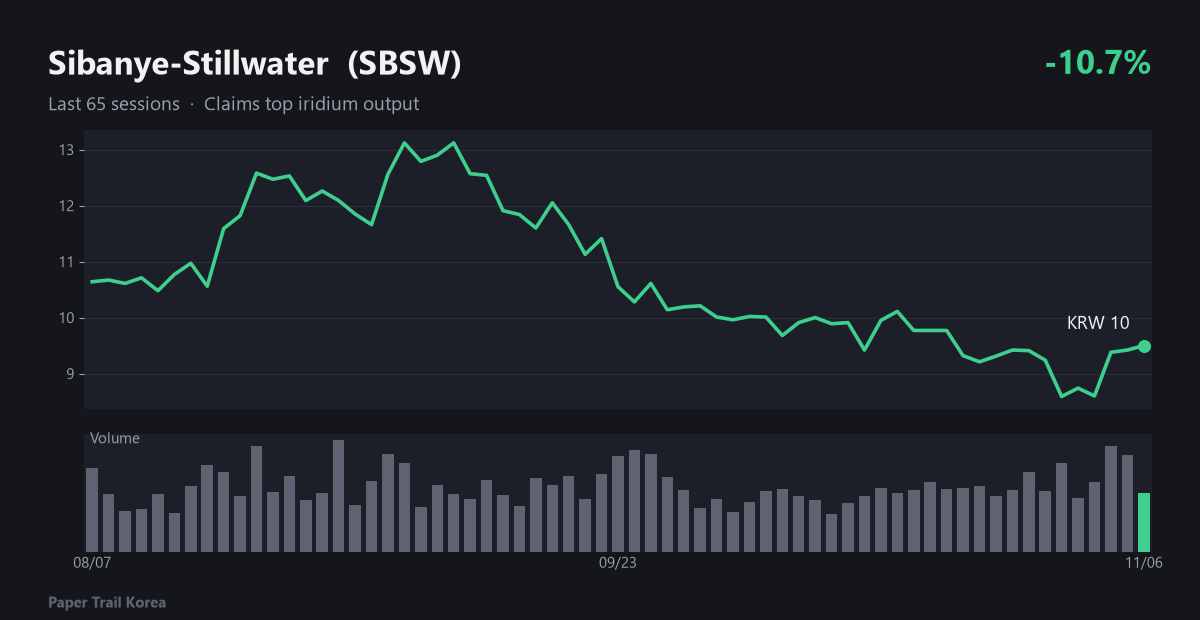
The company mines and refines platinum-group metals (PGMs) in South Africa and the United States. Its CEO has described it as the world's largest primary iridium producer (Skillings). Iridium is only part of the PGM business, though, so theme revenue is small and mixed in with other metals. Third-quarter adjusted EBITDA of R10.8 billion (Fintel) is a company-wide figure. The shares are down 10.7% since 2026-08-07 and 27.6% below the period high. On November 6, Yahoo Finance reported the company cut its annual U.S. PGM production forecast.
In the past month the company filed several 6-Ks (foreign issuers' current reports) and a 13G/A (a change in large holdings). None of the filings in our data covers an iridium supply deal. Next, look for a long-term iridium supply contract with an electrolyzer maker and for iridium and PGM price announcements. On the other side, a ruthenium-based catalyst that uses 85% less iridium, which the company helps develop, could cut iridium demand if adopted at scale. South African political and power problems that disrupt output are another risk.
Chemours: it makes the membrane, but recent news is about cooling fluids
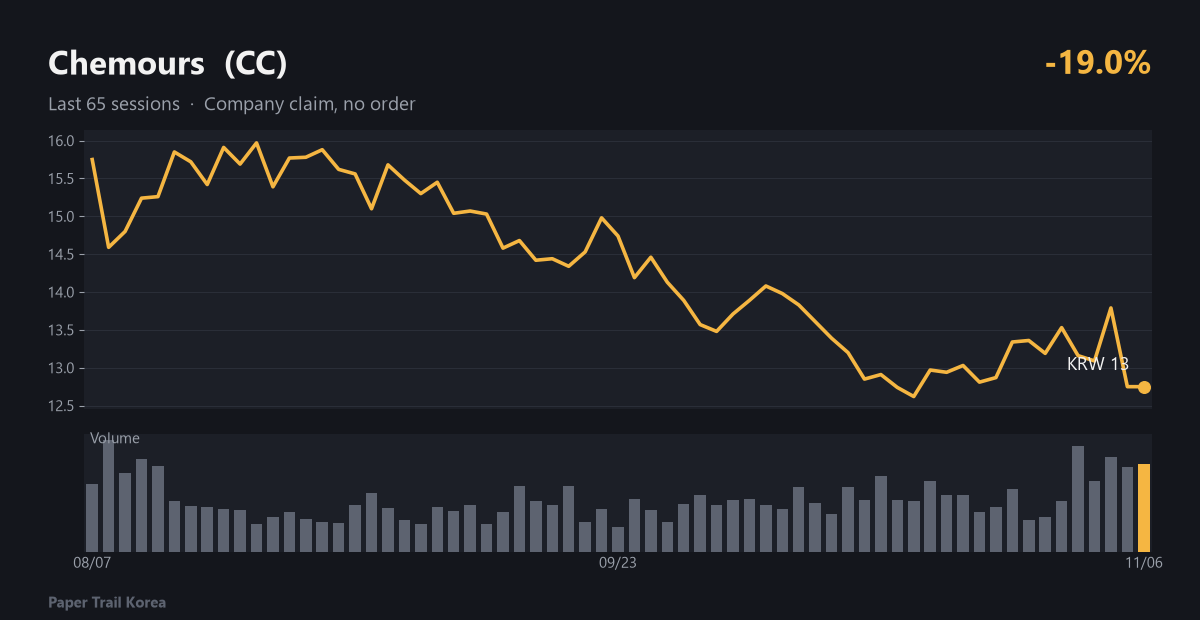
Chemours makes PEM electrolyzer PFSA ionomer and membrane (Nafion). It calls itself a global leader in the field and is part of a $60 million U.S. Department of Energy grant program to develop a next-generation low-resistance membrane (CSRwire, 2024). No large electrolyzer order is confirmed in our data, and the share of its revenue from electrolyzers is not given. Gross margin was 18.0%, up 2.6 percentage points from the prior quarter (Paper Trail research note). Recent news centers on Faizeon, a liquid cooling product for AI data centers, a different business from hydrogen. The shares are down 19.0% since 2026-08-07 and 20.2% below the period high.
Filings in the past month were a 10-Q (quarterly report), a 10-K/A (an amended annual report) and an 8-K announcing third-quarter results. None describes a membrane order. Next, look for a new large Nafion order from an electrolyzer maker and for the outcome of the PFAS (so-called forever chemicals) lawsuits. Our note records ROE of -68% and a debt ratio of 2,622%, a financial risk close to negative equity. A large loss in the lawsuits, a share sale or a credit downgrade could hit the company regardless of the theme. A rival ion-exchange membrane supplier weakening its pricing power would also count against it.
IperionX: it has titanium powder, but no electrolyzer order is visible
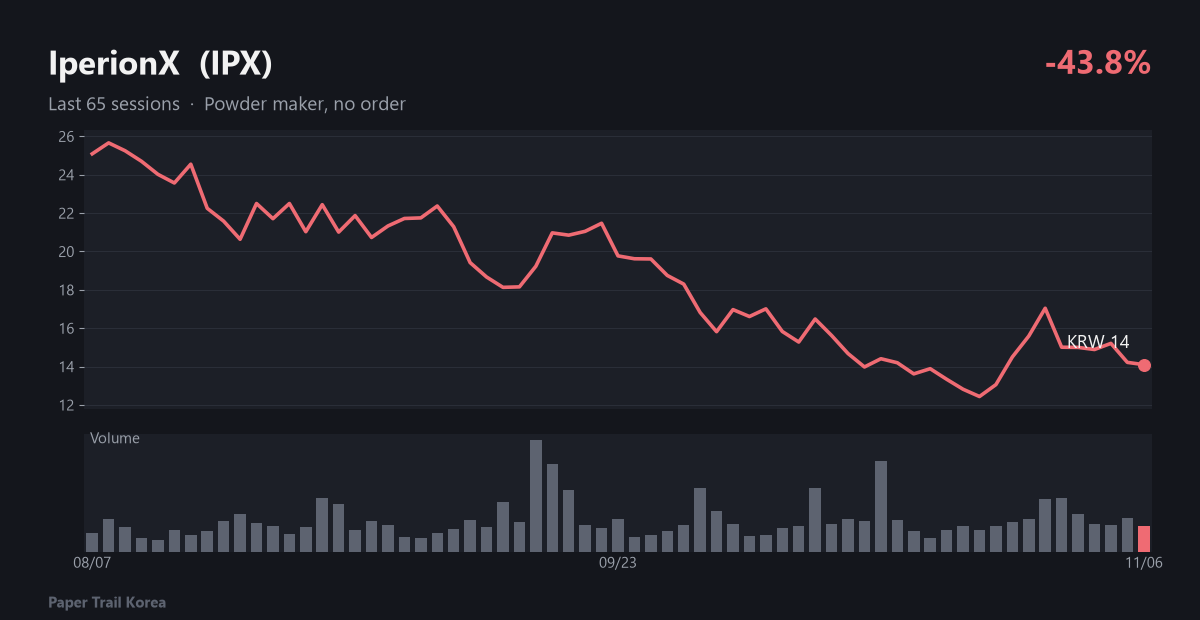
IperionX makes low-carbon titanium metal powder, which can feed PTL and bipolar plates in electrolyzers. That is its link to the theme. The Ti-PTL being tested by a Korean hydrogen company comes from Enerich, which is unlisted and separate from IperionX. On November 5, TradingView reported that a feasibility study for the Titan project showed strong economics for U.S. critical minerals. That concerns the titanium business generally and does not confirm an electrolyzer order. The shares are down 43.8% since 2026-08-07 and 45.1% below the period high.
Two 6-Ks were filed in the past month, but our data does not show their content, and we have no basis to call them theme-related. Our research note has no confirm or deny list for this stock, so we watch two things: whether an electrolyzer maker discloses an order for the company's powder, and how funding for the move from pilot facility to commercial scale proceeds (Kalkine). The hydrogen demand figure is the company's own market analysis.
Platinum Group Metals: whether the mine yields iridium has to be settled first
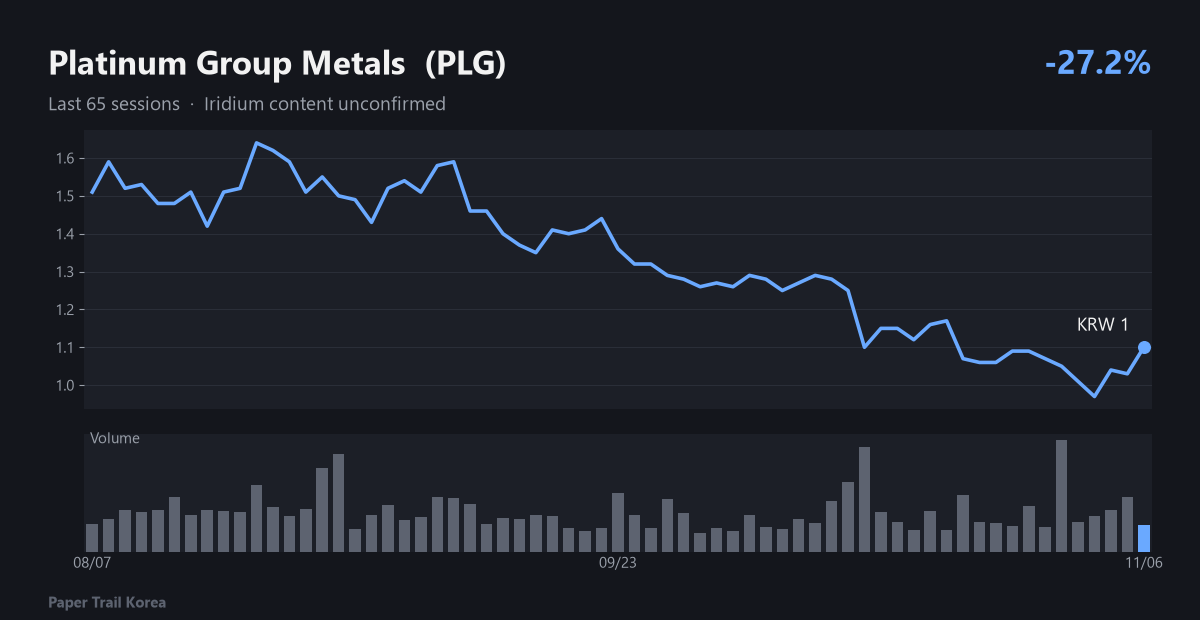
The company is developing a new platinum-group mine in South Africa. Our note says only that the mine may contain iridium. Iridium content, production timing and sales contracts are not in our data. The shares are down 27.2% since 2026-08-07 and 32.9% below the period high. Its only filing in the past month was a 13G/A on large holdings, with no confirmed link to the theme. We found no recent news tied directly to it.
Whether this company can ease the bottleneck depends on the mine reaching production and iridium being recovered from its concentrate. Platinum mines take more than 10 years to expand. Next, look for iridium content data and a production schedule. South African political and power risks remain.
What to watch out for in this theme
- Iridium use can be cut. A ruthenium-based catalyst uses 85% less iridium than iridium oxide (Skillings), and Johnson Matthey's own calculation assumes a 75% cut in loading. If the bottleneck eases, iridium producers' share of the gain could shrink.
- Almost no company is a pure play. Iridium is one part of the PGM business, and the purest suppliers, Johnson Matthey, Umicore and Tanaka, are listed only in the UK, Europe and Japan. The U.S.-listed companies above have small or mixed theme revenue.
- Demand rests on policy and funding. Electrolyzer installations rising to tens of gigawatts assume EU, Korean and U.S. decarbonization policy and industrial hydrogen demand, as in our research view. If installation slips, the bottleneck arrives later. Some sources date from 2023-2024, and IperionX's demand estimate is a company claim.
- Non-bottleneck constraints loom large. Chemours faces PFAS lawsuits and heavy debt, and IperionX must fund commercial scale. In Korea, Airrain (163280.KQ) works on ionomers and PGM recycling, but it has a market cap of about 40 billion won and little public information, so its roll-to-roll utilization and order filings need more checking.