Flying Cars Will Strain Aviation-Grade Battery Cells First, Not Airframes
When eVTOLs (electric vertical take-off aircraft) move to volume production, the first part to run short is the flight-certified battery cell. Prepreg and fly-by-wire actuators follow; here are the listed makers and what each has confirmed.
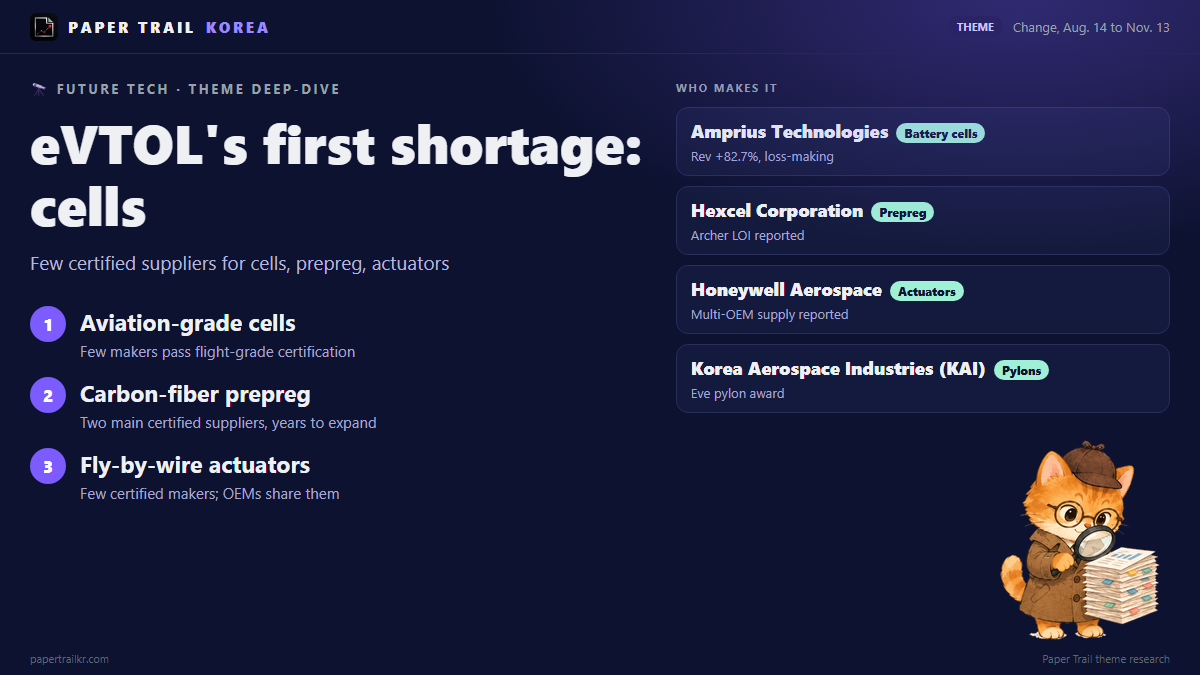
Seoul — Paper Trail's own theme research (researched 2026-11-14 11:05) collects institutional estimates that put the eVTOL (electric vertical take-off and landing aircraft, the so-called flying car) market at $1.7 billion to $5.7 billion in 2035, with 2030 estimates of $0.5 billion to $2.3 billion that vary widely by source. What they share is a jump from dozens of prototypes to hundreds or thousands of production aircraft. The part that runs short first is the battery cell that can deliver high power at take-off and has passed aviation safety conditions.
| Stock | Part it covers | Nature of the catalyst | Evidence | What to check next |
|---|---|---|---|---|
| Amprius Technologies (AMPX) | Silicon-anode battery cells for aircraft | Expectation | Filing confirmed | Purchase orders from Joby, Archer and others |
| Hexcel Corporation (HXL) | Aerospace-grade carbon-fiber prepreg | Expectation | Press reports only | New supply contracts with eVTOL customers |
| Honeywell Aerospace (HON) | Fly-by-wire actuators and integrated avionics | Expectation | Press reports only | Whether eVTOL revenue is broken out |
| Korea Aerospace Industries (KAI) | Certified aerostructure sub-assemblies (pylons) | Expectation | Press reports only | Deliveries and revenue from the Eve pylon deal |
All four stocks fell over the price window (first trading day, Aug 14–18, to Nov 13): Amprius Technologies -36.6%, Hexcel Corporation -23.6%, Honeywell Aerospace -4.9%, Korea Aerospace Industries (KAI) -25.4%. Each is the same distance below its high for the period. The "part it covers" column names the bottleneck each company handles.
Bottleneck 1: Aviation-grade battery cells
Unlike a car battery, an eVTOL cell must release a large current at take-off and pass extreme safety conditions. Our research note lists Amprius, the unlisted EPS and Molicel as the few suppliers with such cells. Qualifying a new cell takes years.
The supply chain adds a second constraint. ZAG Daily, citing Benchmark Mineral Intelligence, reports that China makes more than 70% of the world's lithium-ion cells and more than 90% of graphite anode material, which makes a shift to non-Chinese supply hard.
The pack is also a large share of each aircraft. Roland Berger estimates, cited by ZAG Daily, put battery packs at 30–40% of an eVTOL's total cost. The pack is a consumable that must be replaced after hundreds to thousands of cycles, so more aircraft in service means repeat demand.
Bottleneck 2: Aerospace-grade carbon-fiber prepreg
Prepreg is carbon fiber pre-soaked in resin, the sheet material used to build the airframe. Only a handful of firms, including Hexcel and Toray, can make certified prepreg in volume, and a new line takes years to build.
Our note says nearly every major eVTOL program (Joby, Archer, SkyDrive, Lilium, Overair) depends on this small group. A Joby-Toray long-term supply deal (airframer) and an Archer-Hexcel letter of intent (LOI) are confirmed. Larger, longer-range aircraft use more carbon fiber each, and demand rises roughly in line with build rates.
Bottleneck 3: Fly-by-wire actuators
Fly-by-wire replaces mechanical linkages with electrical signals, and actuators turn those signals into movement of wings and rotors. Few suppliers can get such systems certified, mainly Honeywell and Moog. According to evtol.news, Honeywell supplies Archer (actuators, thermal management), Vertical (flight controls, Anthem avionics), Lilium and Supernal at the same time.
Each aircraft needs many of them. Safety demands redundant actuators, and eVTOLs carry 6 to 12 rotors versus a helicopter's one or two, so actuators and motor controllers scale with the rotor count.
Amprius Technologies: revenue is climbing, but losses and eVTOL orders are open questions
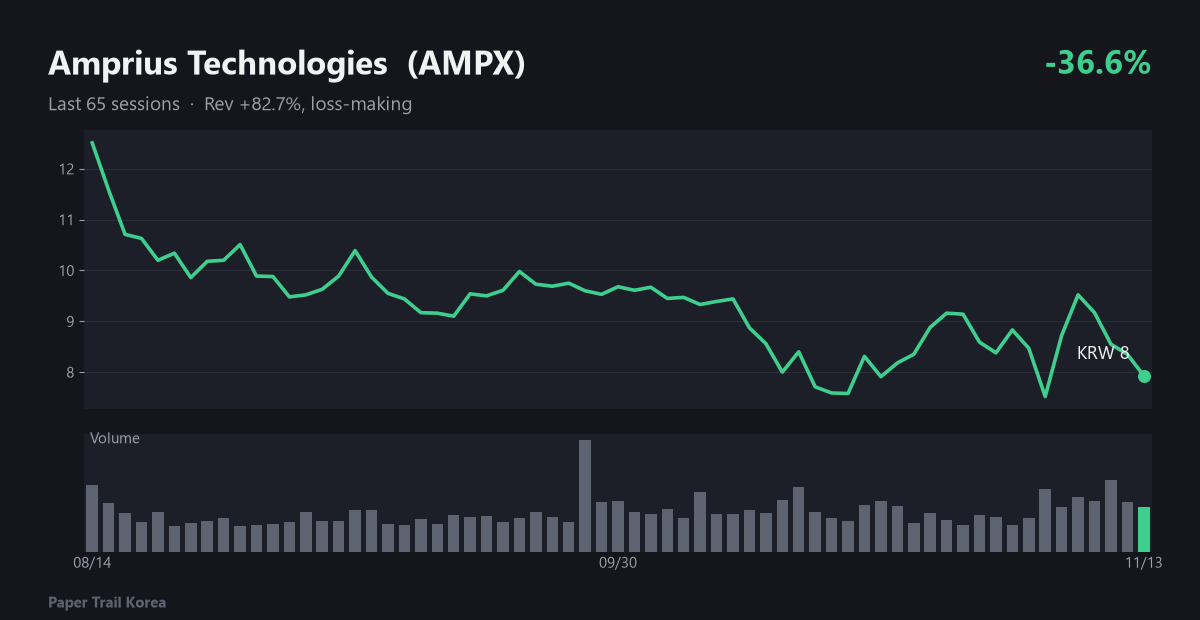
Amprius Technologies makes high-energy-density cells with a silicon anode. Our research shows revenue up 82.7% year on year and gross margin of 26.9%, up 11.4 percentage points from a year earlier. Net margin is -28.4% and free cash flow is negative. How much of the revenue comes from eVTOL customers is not shown in the data. A Yahoo summary of the earnings call says the company raised its 2026 revenue outlook to $145 million.
In the past month the company filed an 8-K with third-quarter results on Nov 10 and a 10-Q on Nov 12. Both are earnings filings, and there is no filing announcing an eVTOL purchase contract. Next, check whether Joby, Archer or Supernal move from letters of intent to purchase orders, and whether gross margin returns above 30%. Large cell-capacity additions by Molicel or EPS, a key customer making cells in-house, or another share sale would point the other way.
Hexcel Corporation: strong in the material, but eVTOL volume is still at the contract stage
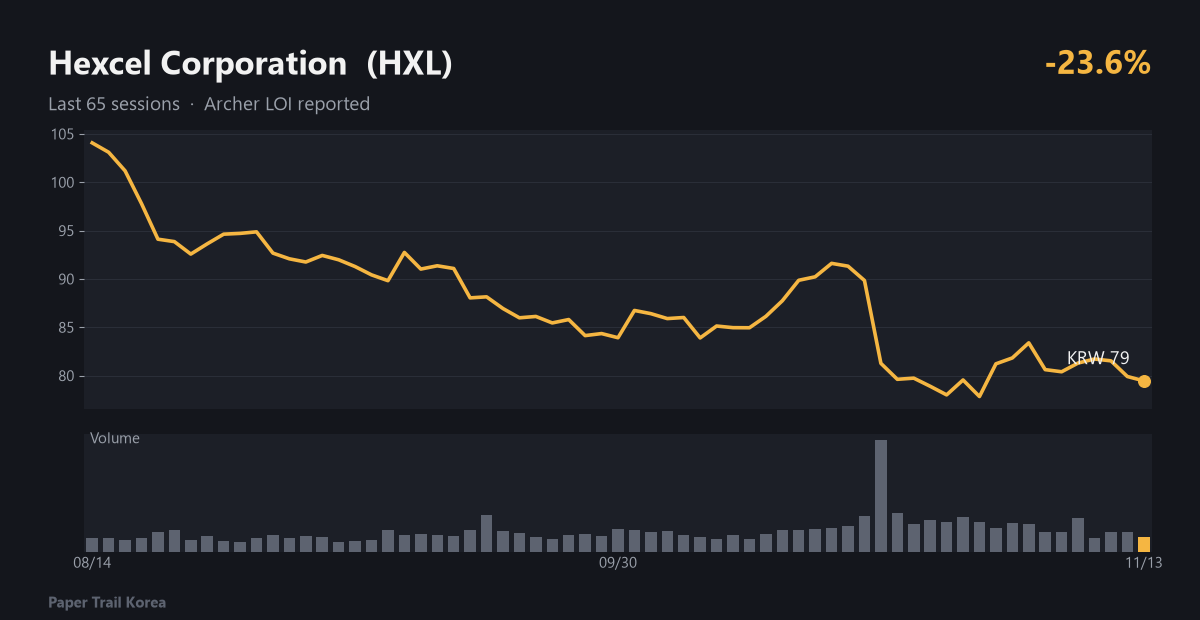
Hexcel Corporation makes aerospace-grade carbon-fiber prepreg and, with Toray, forms the two-supplier core of the market. The Archer LOI is confirmed, but actual volumes and revenue are not in the data. Most of its sales come from conventional aerospace such as Boeing and Airbus, so the eVTOL share is likely small. Gross margin was 23.3%, down 2.8 percentage points from the prior quarter.
In the past month the filings were the Oct 21 third-quarter 8-K and 10-Q and insider Form 4s. None ties directly to this theme. Next, look for new supply contracts or volume increases with Archer, Joby or similar customers, and for eVTOL orders accelerating together with Boeing and Airbus output. A large aerospace-grade prepreg expansion by Toray or a newcomer, or certification delays at major eVTOL makers, would be warning signs.
Honeywell Aerospace: many makers rely on it, but its eVTOL share is not visible
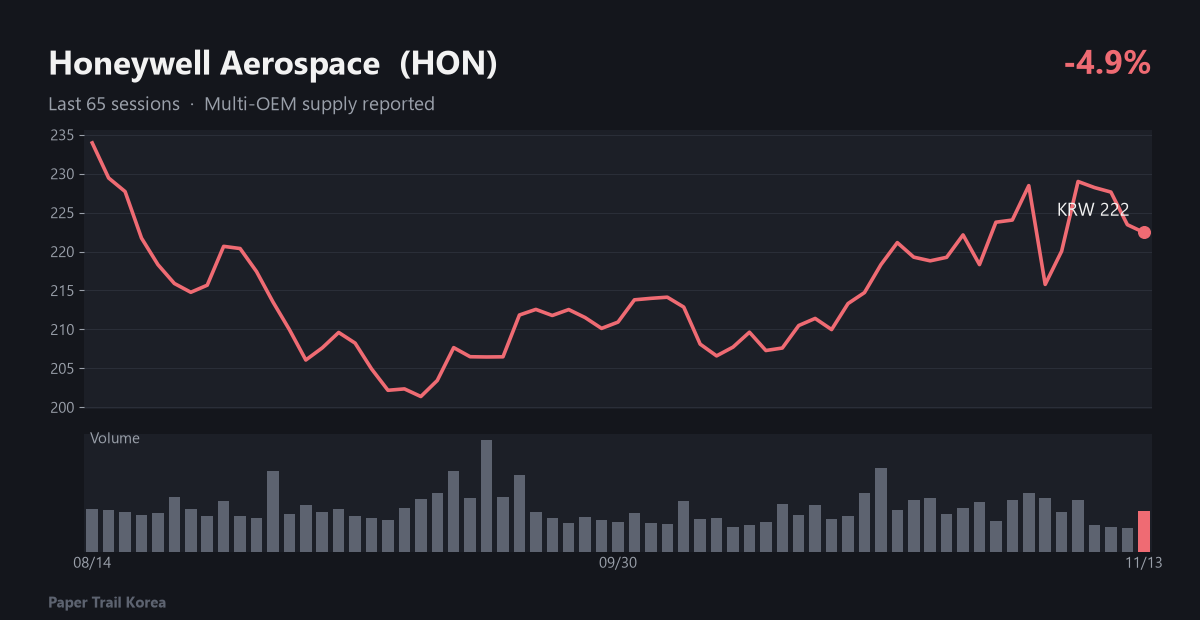
Honeywell Aerospace supplies actuators, integrated avionics (Anthem) and thermal management. The evidence for the bottleneck is that several eVTOL makers depend on the same supplier. But it is a segment of a large conglomerate with a market value of about $70.6 billion, and our own note says eVTOL purity and leverage are low. No eVTOL revenue line is confirmed.
In the past month the filings were the Oct 22 third-quarter 8-K and 10-Q plus insider Form 4s and Form 144s. None relates to the theme. Next, check whether results material breaks out eVTOL revenue and whether new makers are announced. Joby's powertrain and actuation parts are built by Toyota under a long-term agreement, so makers that bring parts in-house can shrink the outside suppliers' share.
Korea Aerospace Industries (KAI): a pylon contract exists, but fighters dominate sales
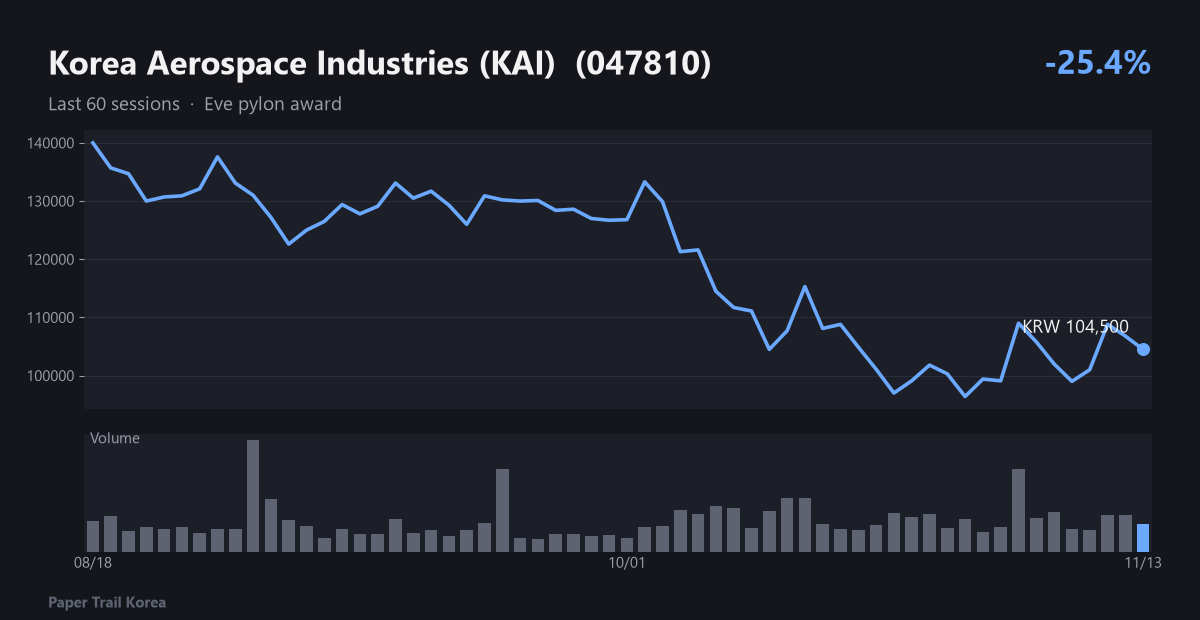
In 2024, Eve Air Mobility selected KAI to supply eVTOL pylons, the structures that hold the electric motors and propellers. militaryaerospace.com reported a contract value of about $723 million (roughly KRW 1 trillion). Most of the company's revenue, however, comes from FA-50 and KF-21 fighter programs, so eVTOL exposure is diluted.
There has been no filing on this theme in the past month. DART shows the Nov 3 preliminary earnings disclosure, an IR event notice and futures/options price-limit notices. Next, check whether the Eve pylon work turns into deliveries and revenue, and whether investment in certified production capacity goes ahead. A delay on the Eve side would push back structure demand as well.
What to watch out for in this theme
- Market estimates diverge widely. The range is $0.5–2.3 billion for 2030 and $1.7–5.7 billion for 2035, a gap of four to five times. Commercial service only expands after FAA and EASA certification. Joby is still running certification flight tests and preparing early operations (Aviation Week, November 2026).
- Demand-cut signals already exist. According to SBS, Hanwha Aerospace cancelled a KRW 454.8 billion UAM parts contract with Vertical Aerospace in August 2026 as a strategic decision. Volocopter said it finished reorganizing its supply chain but admitted some key parts still face longer lead times.
- Makers can source parts themselves. As in the Joby-Toyota case, when a manufacturer builds key parts or hands them to a large shareholder, the share left for outside listed suppliers shrinks.
- Theme revenue is small or mixed at each company. Honeywell Aerospace and KAI have far larger core businesses, and Hexcel Corporation is centered on conventional aerospace. Amprius Technologies, the closest to pure exposure, carries losses and the risk of further share sales.