Robotaxi Stocks: The Real Bottleneck Is Lidar and Camera Modules
Tesla targets 2 million Cybercabs a year. If cars scale, lidar and camera modules may run short before AI chips do. We checked who makes them, and what argues against the theme.
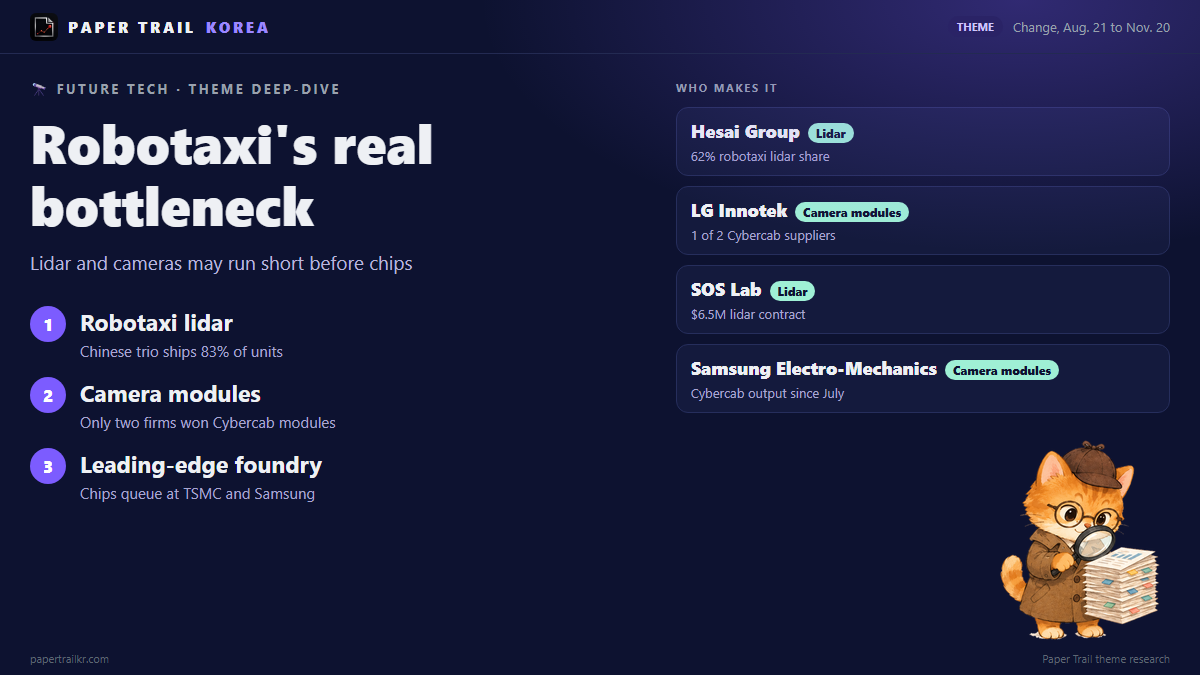
Seoul — Tesla is targeting production of 2 million Cybercabs (its steering-wheel-free robotaxi) a year, News1 reported. If Waymo, Zoox and Chinese operators also move to volume, each car carries more and better sensors. According to Paper Trail's own theme research (researched 2026-11-21 11:08), the first part to run short is lidar (a sensor that measures distance with laser pulses), not the AI chip. TechInsights expects Hesai, RoboSense and Huawei to supply 83% of high-resolution lidar shipments in 2025.
At a glance
| Stock | Bottleneck part | Nature of the news | Evidence | What to check next |
|---|---|---|---|---|
| Hesai Group | Robotaxi lidar | Expectation | Press reports only | Public robotaxi lidar orders; gross margin in November results |
| LG Innotek | Cybercab camera modules | Expectation | Press reports only | Added orders; production revenue figures |
| SOS Lab | Solid-state and 3D lidar | Substantive, lasting | Filing confirmed | Follow-on orders after the North American contract |
| Samsung Electro-Mechanics | Cybercab camera modules | Expectation | Press reports only | Disclosed Cybercab revenue contribution |
All four stocks are down sharply over the past two to three months. KOSPI fell 5.21% on Nov. 20.
Bottleneck 1: Robotaxi lidar, with few makers left
The lidar market has consolidated fast. Hesai, RoboSense and Huawei held 77% of the total lidar market in 2024 (Hesai 33%, RoboSense 24%, Huawei 19%), according to Money Today. Western rivals have fallen away. Luminar filed for Chapter 11 in December 2025, Quanergy and Ibeo went bankrupt, and Velodyne restructured. New production lines take one to two years. Hesai's second Thai plant is due in 2027.
Demand scales per vehicle. A robotaxi carries three to six lidar units, against zero to one on a typical ADAS (driver-assistance) car. Yole Group put Hesai's 2025 share of robotaxi lidar at 62%. Hesai is doubling capacity from 1 million units in 2025 to 4 million in 2026 (TechCrunch).
Bottleneck 2: Cybercab camera modules and image sensors, split between two suppliers
Korean media reported that Samsung Electro-Mechanics and LG Innotek won all Cybercab camera-module orders. Samsung Electro-Mechanics began mass production in July 2026, and LG Innotek is due to start this year. The image sensor chips inside are a Sony and onsemi duopoly. In its own blog, onsemi says few foundries (contract chip factories) can make automotive sensors, so supply disruptions spread wider and last longer than for general chips.
A Cybercab is estimated to carry eight cameras. The required resolution rises from 1.2 megapixels on current Tesla EVs to about 5 megapixels, more than four times higher (Hankyung). Both the number of cars and the pixels per car grow.
Bottleneck 3: Leading-edge foundry capacity for self-driving chips
The top five makers, including Nvidia, Intel (Mobileye) and Qualcomm, hold 69% of the self-driving SoC (system-on-chip) market (Counterpoint). Their chips all queue at TSMC and Samsung's most advanced lines. Tesla's AI5 and AI6 are split between the two, with mass production targeted for 2027 (Tom's Hardware). Nvidia's Thor competes for the same 3nm-class wafer capacity. TSMC, SK hynix and onsemi are not in this article's price data, so we do not cover them here.
Hesai Group: lidar leader with a U.S. political overhang
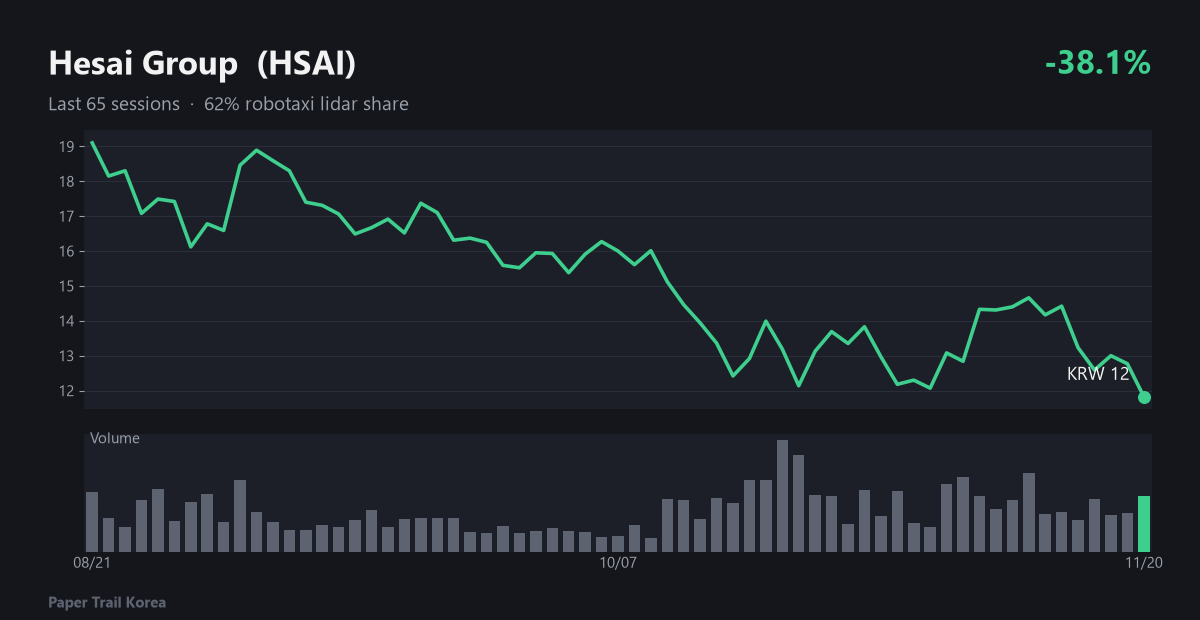
Hesai holds 62% of robotaxi lidar by Yole's count and is listed on both Nasdaq (HSAI) and Hong Kong (2525). The data do not show how much of its revenue comes from robotaxis. The shares are down 38.1% since Aug. 21, and 38.1% below the period high. There have been no filings about this theme in the past month. Several 6-K reports (foreign-issuer current reports) and a Form 4 insider filing appeared in November, but none is confirmed as a robotaxi order. Yahoo reported a $100 million buyback plan running 12 months from Nov. 18.
Two things to check: a public lidar order or price increase from a robotaxi operator, and whether gross margin (now 41.0%) rebounds in November results. Our research notes show earnings estimates were cut over the past 90 days. Delisting from Nasdaq, or a Pentagon 1260H listing (a list of Chinese military-linked companies) that cuts off U.S. customers, would undercut the bottleneck position. U.S. senators called for delisting in September 2025, and a court upheld the 1260H designation.
LG Innotek: Cybercab supply is reported, but margins are thin
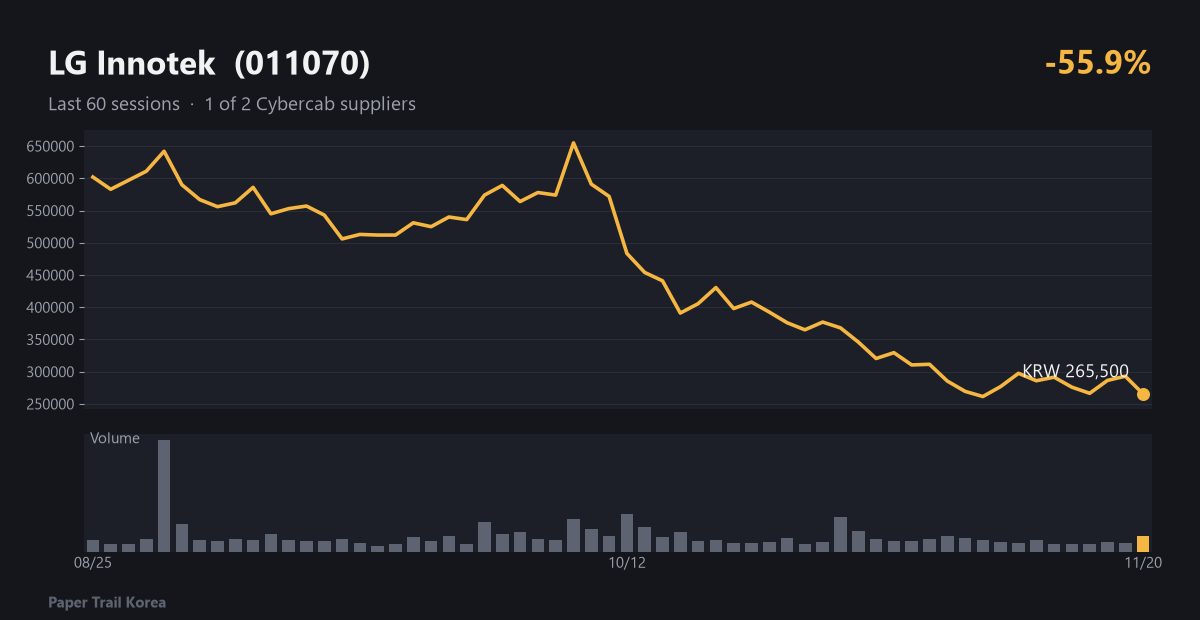
LG Innotek is reported to share all Cybercab camera-module supply with Samsung Electro-Mechanics. Our research also notes it supplies Amazon's Zoox. No public figure shows what share of revenue Cybercab will be, and its substrate business mixes into the total. The shares are down 55.9% since Aug. 25 and 59.5% below the period high. There have been no filings on this theme in the past month. The recent ones were preliminary earnings on Oct. 27, a share cancellation on Nov. 6, and a corporate value-up plan notice and a serious-accident amendment on Nov. 19.
Watch for added camera-module order filings and for Cybercab production showing up in revenue. Gross margin matters too. It is 6.2% now, down 3.4 points from the prior quarter and 2.7 points from a year ago. If Tesla brings module production in-house, or a new entrant breaks the two-supplier structure, the case weakens.
SOS Lab: contract filed, but small and under a short-selling ban
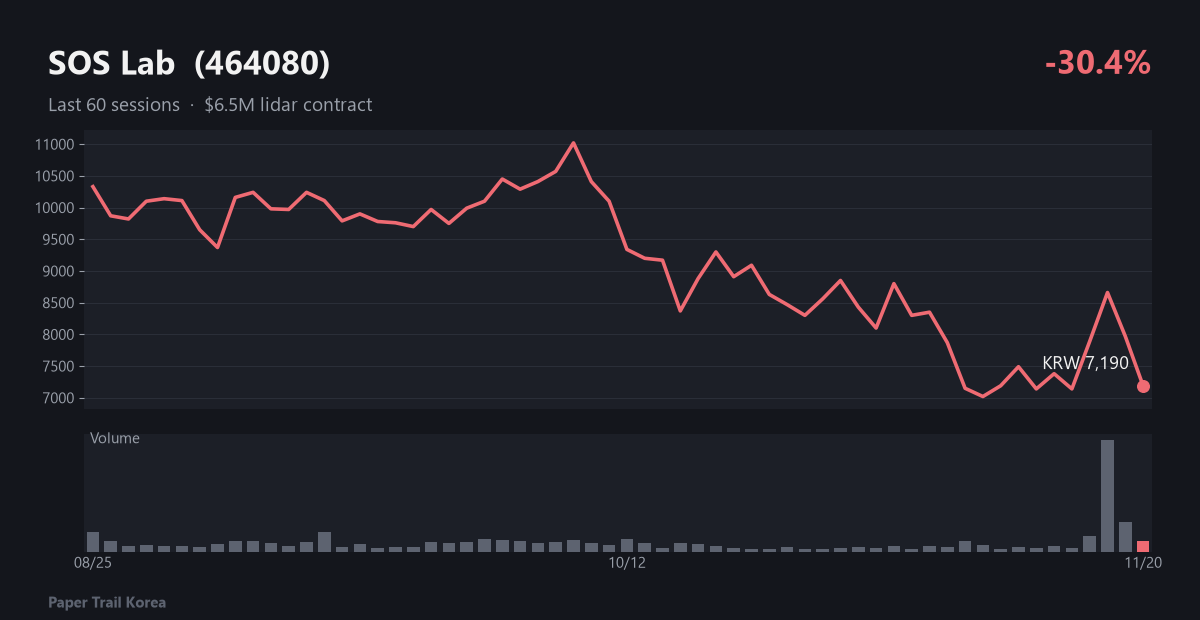
SOS Lab is a KOSDAQ-listed maker of solid-state and 3D lidar. On Nov. 18 it filed a $6,515,420 (about 8.7 billion won) supply contract with a North American big-tech company for autonomous-driving and physical-AI lidar (Newsis). Reports say it is an official Nvidia lidar partner and that its supply to Hyundai Motor Group's Robotics Lab platform is confirmed. The filing alone does not show whether the contract is for robotaxis. Our research notes put its market cap near $0.1 billion, the smallest of the four. The shares are down 30.4% since Aug. 25 and 34.8% below the period high. It was designated a short-selling overheated stock on Nov. 19, with the ban extended on Nov. 20.
Watch for follow-on orders and for lidar's share of revenue. With Chinese makers dominating, how much customers will buy from a Korean supplier is also open.
Samsung Electro-Mechanics: Cybercab production started, but this is not a single-theme company
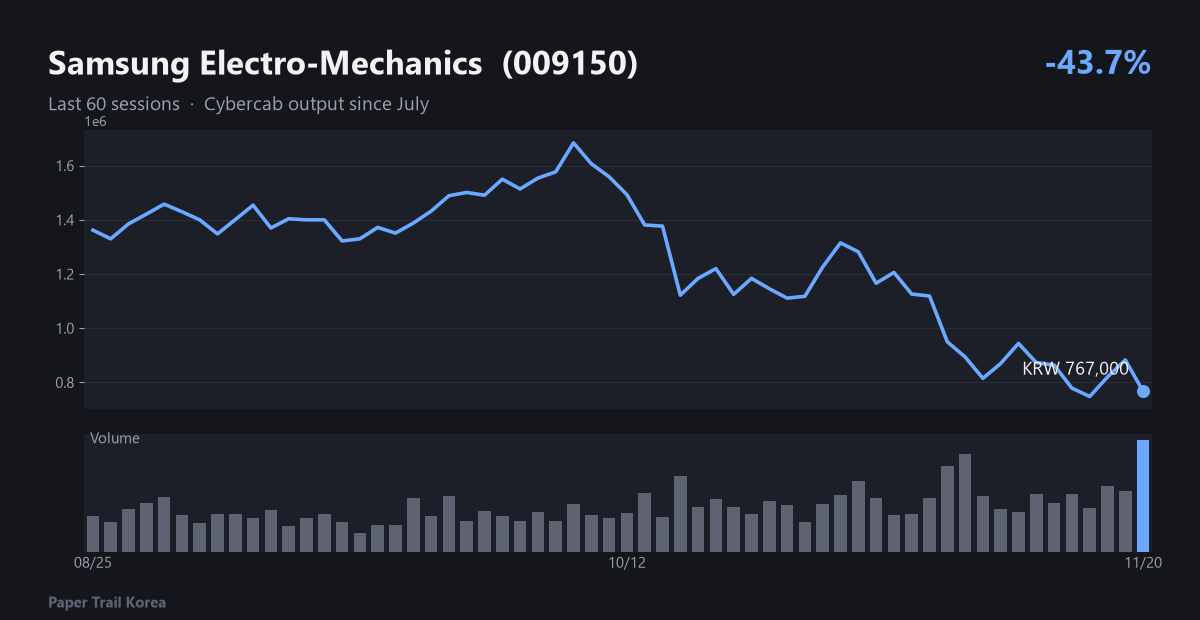
Samsung Electro-Mechanics is reported to have started Cybercab camera-module production in July 2026. It also makes Nvidia GPU substrates and MLCCs (multilayer ceramic capacitors, small parts on circuit boards), so Cybercab may be a small part of sales. The shares are down 43.7% since Aug. 25 and 54.5% below the period high. A single-sale supply contract was filed on Oct. 30, but the title alone does not show whether it relates to Cybercab. Notices of wider price limits on stock futures and options also ran repeatedly in the period.
Watch for a disclosed figure for Cybercab's revenue contribution, and for any change in the camera-module supply structure. If Tesla decides to build modules itself, both Korean suppliers' positions change.
What to be careful about in this theme
- Promised demand has vanished before. When Luminar went bankrupt, Volvo's 1.1 million-unit contract was withdrawn and actual purchases were 10,000 units (TechCrunch). A production target is not an order.
- Camera-only designs could spread. If major automakers drop lidar, the lidar bottleneck loses meaning.
- Politics and regulation are large factors. Hesai faces a delisting call and the 1260H listing. A market dominated by Chinese suppliers could limit U.S. purchases.
- Theme revenue is small or mixed. Samsung Electro-Mechanics and LG Innotek are diversified, and SOS Lab's contract is 8.7 billion won. On Nov. 20, KOSPI fell 5.21%, KOSDAQ 5.71% and Nasdaq 5.28%. Overall market moves are driving prices more than the theme.