Quantum Computing Stocks? The Real Bottleneck Is Helium-3
As superconducting quantum computers scale, the first things to run short are helium-3 and dilution refrigerators. Most of the leading suppliers are private, and listed companies have small or diluted exposure.
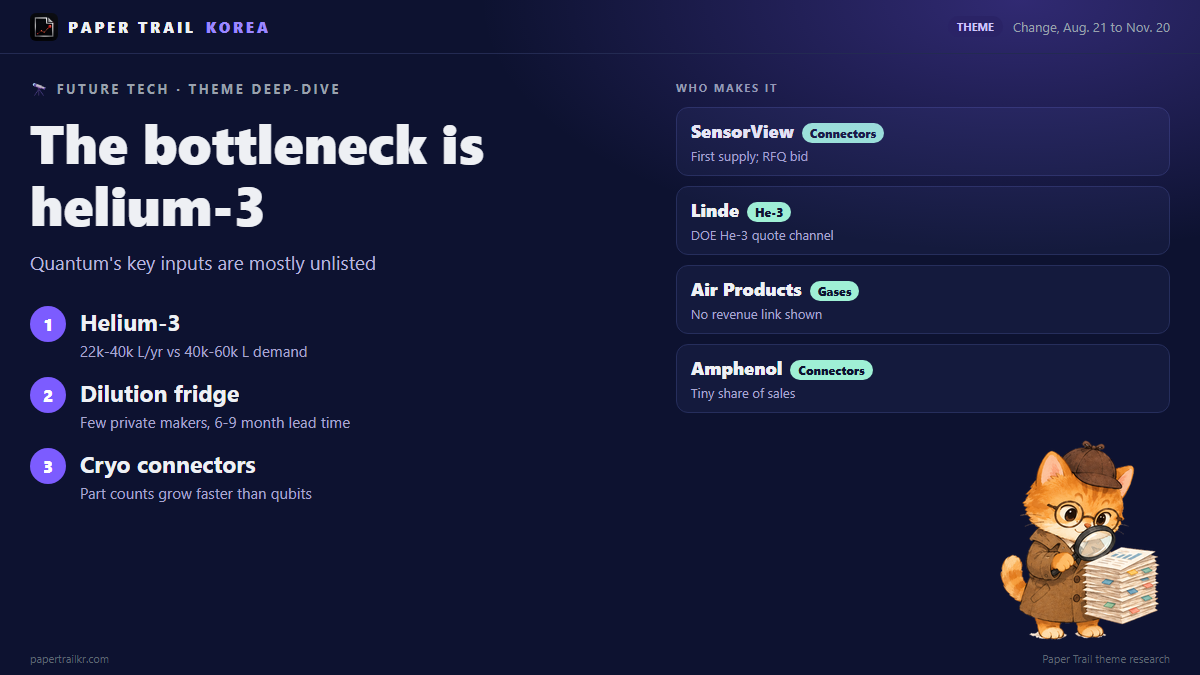
Seoul — The market for dilution refrigerators (machines that cool qubits to cryogenic temperatures) and the related cryogenic supply chain is estimated to grow from $450–700 million in 2026 to $2.16–3.36 billion in 2036, a CAGR of about 17% (Meticulous Research). When qubits (the basic computing units of a quantum computer) multiply, the first thing to run short is not the chip but the helium-3 that fills the refrigerators. Paper Trail's own theme research, as of 2026-11-22 11:17 KST, reaches that view.
At a glance
| Stock | Bottleneck part | Nature of the news | Evidence | What to check next |
|---|---|---|---|---|
| SensorView (321370) | Cryogenic RF connector and attenuator module | Expectation | Reports only | Whether a U.S. customer's RFQ turns into a disclosed order |
| Linde (LIN) | Helium-3 supply and distribution (DOE sales channel) | Expectation | Reports only | Whether helium-3 revenue is broken out |
| Air Products (APD) | Helium-3-related industrial gas | Expectation | Reports only | Whether specific helium-3 contracts are disclosed |
| Amphenol (APH) | Superconducting (Nb-Ti) cryogenic connectors | Expectation | Reports only | Whether quantum-related revenue is reported separately |
The second column is the bottleneck part each company handles. All four stocks are lower over the period. The moves below are measured from the first trading day in the window (Aug 21–25) and from the period high.
Bottleneck 1: Helium-3, why it is scarce
Helium-3 makes up only 1.37 parts per million of natural helium. Nearly all supply is a byproduct of the decay of tritium kept for nuclear weapons, so better processes cannot raise output. Global production is estimated at about 22,000–40,000 liters a year against demand of 40,000–60,000 liters, already a structural deficit (postquantum.com, citing USGS estimates).
The research notes put the price at $1,900–2,600 per liter in bulk and above $10,000 for purified grades, up from $40–85 before. One dilution refrigerator takes tens of liters: 40 liters for a Bluefors XLD1000sl, about $100,000 of helium-3 (postquantum.com). Every new installation creates fresh demand for a fill.
Some relief is in view. Bluefors signed a deal with private company Interlune for up to 10,000 liters a year of helium-3 over 2028–2037 (The Quantum Insider). The U.S. Department of Energy says its inventory management can meet federal demand for decades (Innovation News Network).
Bottleneck 2: Dilution refrigerators, why they are scarce
A few private companies share the market: Bluefors, Oxford Instruments (acquired by Quantum Design in January 2026) and Janis. Bluefors has a lead time of 6–9 months, and its Syracuse, New York plant builds about 20 units a year. More than 1,500 units have shipped worldwide (War on the Rocks).
More qubits mean one unit is no longer enough. Heat from wiring caps a standard coaxial setup at about 140 qubits, so makers need several refrigerators or modular frames. The research notes say price and complexity per system rise faster than the qubit count.
Bottleneck 3: Cryogenic RF wiring and connectors, why they are scarce
Wiring between room-temperature control gear and the qubits carries heat in, and that heat sets the practical ceiling on scaling. The parts must be non-magnetic and use superconducting (Nb-Ti) material. Supply is concentrated in a few private startups such as Quantum Coax and Delft Circuits, plus Japan's Coax Co.
New approaches such as high-density multichannel wiring aim to stretch one frame from 140 to as many as 1,200 qubits. Even so, the research notes say the number and precision of the cables, connectors and attenuators (parts that reduce signal strength) needed grow faster than the qubit count.
SensorView, first supply made, but survival comes first
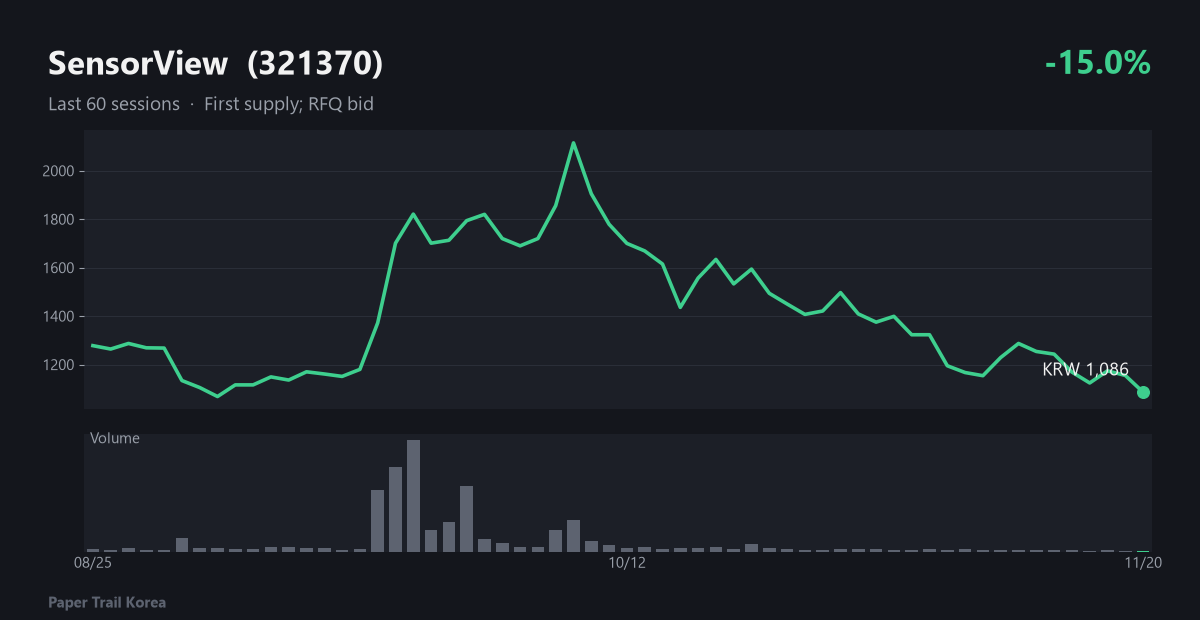
SensorView makes an integrated cryogenic connector and attenuator module. According to Money Today (reported July 3, 2026), it made its first supply to a Korean research institute and is responding to a request for quotation (RFQ) from a leading U.S. quantum computer company. Its market value is about $0.05B (under 50 billion won). If the module business takes off, its share of the company's total sales could be large, which makes it the only one of the four whose exposure is not diluted. There is no confirmed order disclosure yet. Of two filings in the past month, one on Nov 18 named it lead research institute in a defense innovation support program, and one on Oct 30 selected it for a joint research task under a global industrial technology cooperation program. Their titles alone do not show a direct link to quantum parts. The stock is down 15.0% from Aug 25 and 48.7% below its period high (a 2,115 won close on Oct 6).
Its finances are weak. The research notes list a net margin of -98.3%, a debt ratio of 138%, sales down 40.6%, and a past warning for a pre-tax loss equal to 116% of capital, which can lead to a designation as a managed stock. Two things to check: whether the RFQ becomes a disclosed order with quantum or cryogenic connector revenue reported separately, and whether the managed-stock risk eases or debt falls. A collapsed RFQ, a deeper managed-stock listing, or another capital raise would weaken the case. News on this theme was zero over both the past 30 days and 7 days.
Linde, the helium-3 sales channel, but a small part of the company
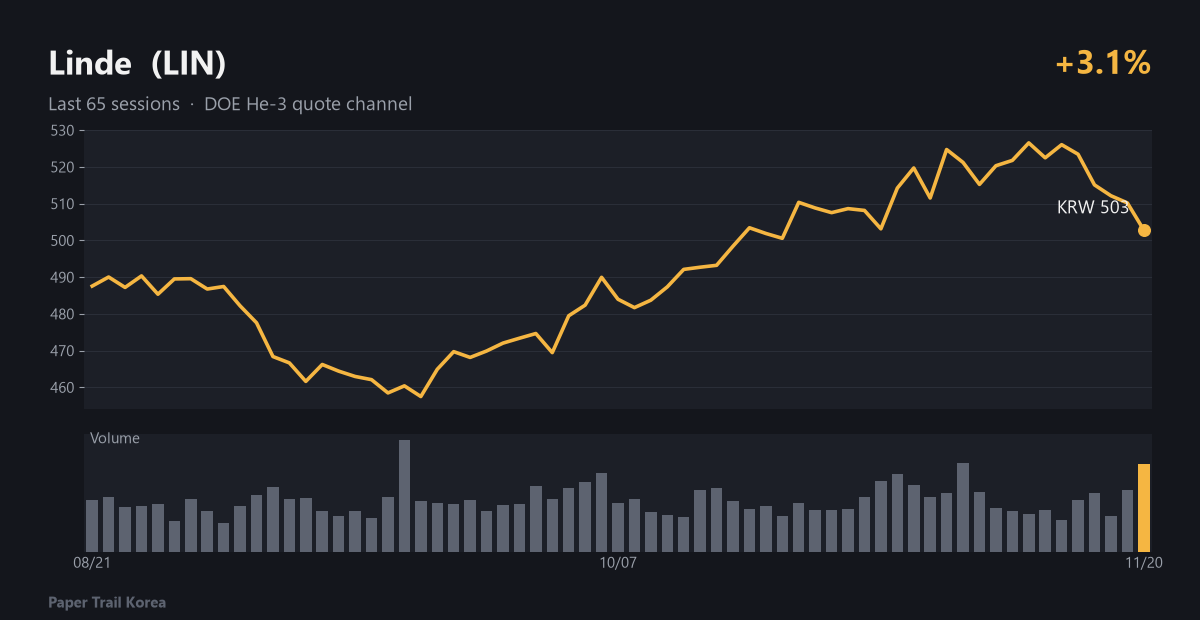
The U.S. DOE isotope site (isotopes.gov) directs requests for quotation on its helium-3 sales through Linde's website. That ties Linde to the official helium-3 distribution channel. But with a market value of $230.84B, it is far larger than the 2036 market estimate of $2.16–3.36 billion. The research notes say helium-3 is an extremely small part of Linde's sales.
There were no filings on this theme in the past month. The Nov 12 8-K covered a euro bond issue (€650 million each of two notes, for general corporate purposes). The stock is up 3.1% from Aug 21 and 4.5% below its period high. Check whether helium-3 revenue gets its own line and whether private customers sign large contracts beyond the DOE.
Air Products, named as a participant, with no revenue link shown
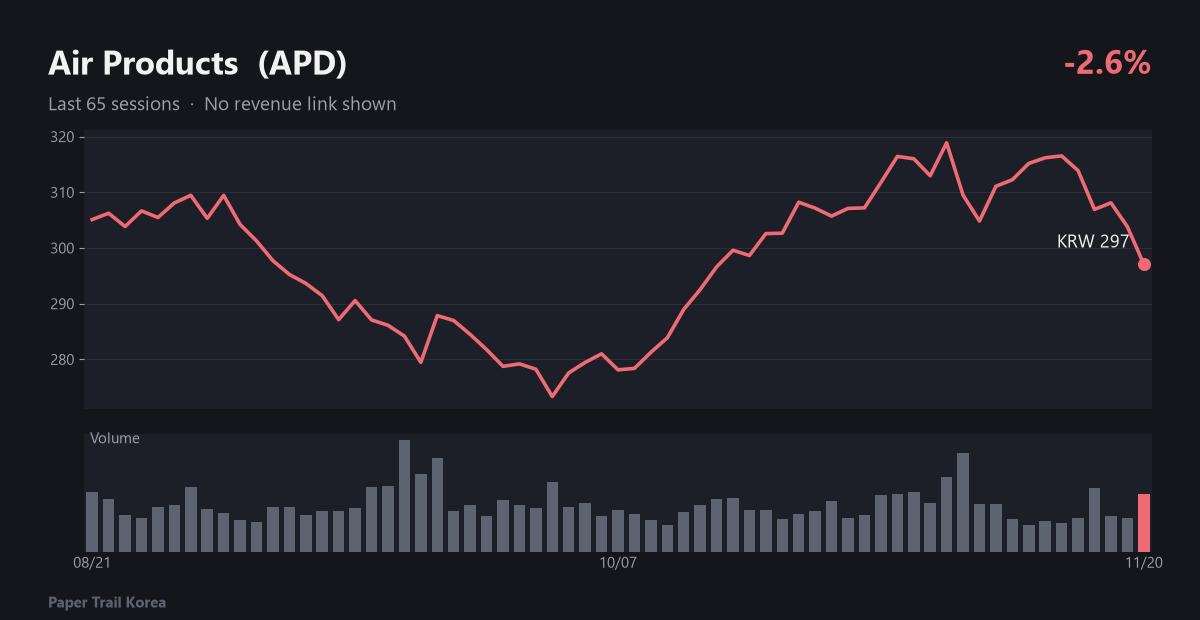
Meticulous Research lists Air Products with Linde and Air Liquide as major participants in helium-3 supply. The research notes find no specific revenue link disclosed beyond that mention, which makes it the weakest case of the four. Its market value is $66.16B.
There were no filings on this theme in the past month. Recent filings were the Nov 19 10-K (annual report), the Nov 20 S-3ASR (a shelf registration for securities) and the Nov 18 board nominee announcement. The stock is down 2.6% from Aug 21 and 6.8% below its period high. Check whether helium-3 supply deals or revenue are disclosed, or whether it stays a single line as a participant.
Amphenol, a superconducting connector license inside a very large company
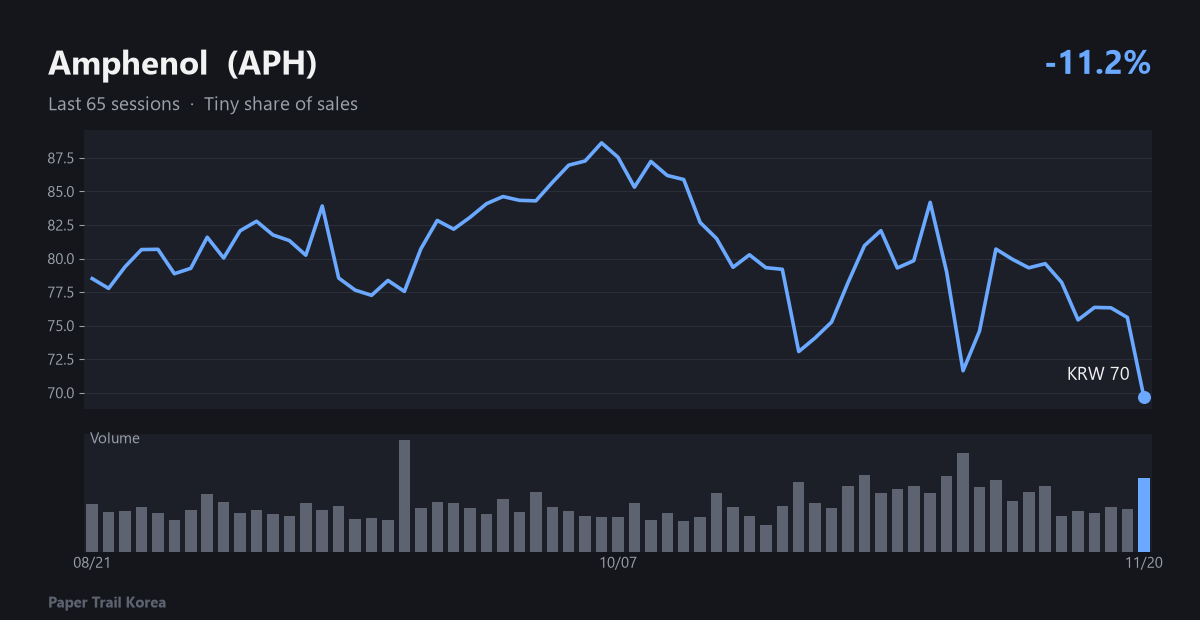
The research notes tie Amphenol to licensed superconducting (Nb-Ti) cryogenic connectors. But they say this business is a very small share of sales for Linde, Amphenol and Keysight alike, and its exposure is heavily diluted. At $172.16B in market value, growth in this theme would barely register in the company's overall results.
There were no filings on this theme in the past month. The Oct 28 8-K covered quarterly results, a dividend increase ($0.125 to $0.15 a quarter) and a $4.0 billion buyback plan starting in 2027. The stock is down 11.2% from Aug 21 and 21.3% below its period high, including a 7.79% fall on Nov 20 alone. Check whether quantum-related revenue is reported separately and whether the Nb-Ti connector reaches volume supply.
What to watch out for in this theme
- The companies holding the bottlenecks are not listed. Bluefors, Interlune, Oxford/Quantum Design and SemiQon are all private. In Korea, Cryo H&I has only signed a lead underwriter for a listing targeted for the second half of 2027, and Withwave has filed for a KOSDAQ preliminary review but is mainly a 5G connector maker.
- Listed exposure is diluted. Linde and Amphenol are far larger than the whole theme market, so growth here would barely move them. Air Products has no disclosed revenue link at all.
- The most direct exposure, SensorView, carries the most financial risk. It has net losses, a 138% debt ratio and a managed-stock warning history, and an RFQ is a quote request, not an order.
- The shortage could ease. Interlune's lunar helium-3 contract, DOE inventory, and cryo-CMOS (control electronics that cut the number of wires) reaching the market could all change today's supply picture.
- The whole market fell. On Nov 20 the KOSPI lost 5.21%, the KOSDAQ 5.71% and the Nasdaq 5.28%. Moves in these stocks that day cannot be pinned on this theme alone.