Satellite Electric Propulsion Stocks: Thrusters and Xenon Run Short First
If electric propulsion scales in the 2030s, Hall thrusters and xenon gas look likely to run short first. We checked how closely four listed companies touch that bottleneck, and what argues against it.
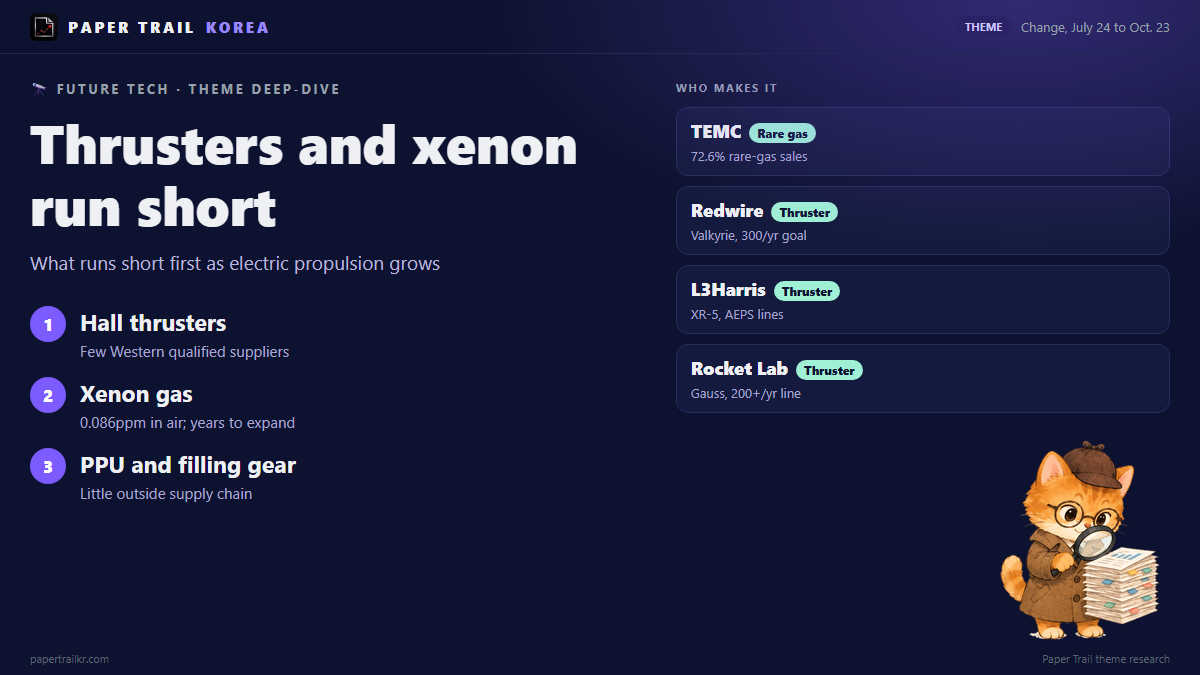
Seoul — If electric propulsion (engines that use electricity to accelerate gas) spreads across satellites, the first thing to run short is not the satellite but the thruster. In a 2016 release, Air Liquide said at least a third of the communications satellite market would move to all-electric designs (no chemical propulsion), and that all-electric engines raise payload capacity by 50%. Paper Trail's own theme research (researched 2026-10-25 11:20 KST) finds that only a handful of Western suppliers have flight-qualified Hall thrusters.
At a glance
| Stock | Why it moved | Nature of the news | Evidence | What to check next |
|---|---|---|---|---|
| TEMC | Refines and sells xenon, krypton and other rare gases | Expectation | None | Xenon/krypton price hikes or long-term supply contracts in filings |
| Redwire | Hall thruster 'Valkyrie' (co-developed with Phase Four) | Expectation | Press reports only | DoD/NASA thruster orders, start of volume production |
| L3Harris Technologies | Hall and ion thrusters (XR-5, AEPS 12kW) from Aerojet Rocketdyne | Expectation | None | Whether thruster revenue is broken out |
| Rocket Lab | Hall thruster 'Gauss', made in-house | Expectation | Press reports only | External Gauss orders, the 200-a-year line running |
Price moves run from 2026-07-27 to 10-23 for TEMC and from 2026-07-24 to 10-23 for the others. TEMC rose 69.7% and sits 9.3% below its period high. Redwire fell 3.8%, L3Harris 15.4% and Rocket Lab 17.7%.
Bottleneck 1: Hall thrusters, with few qualified suppliers
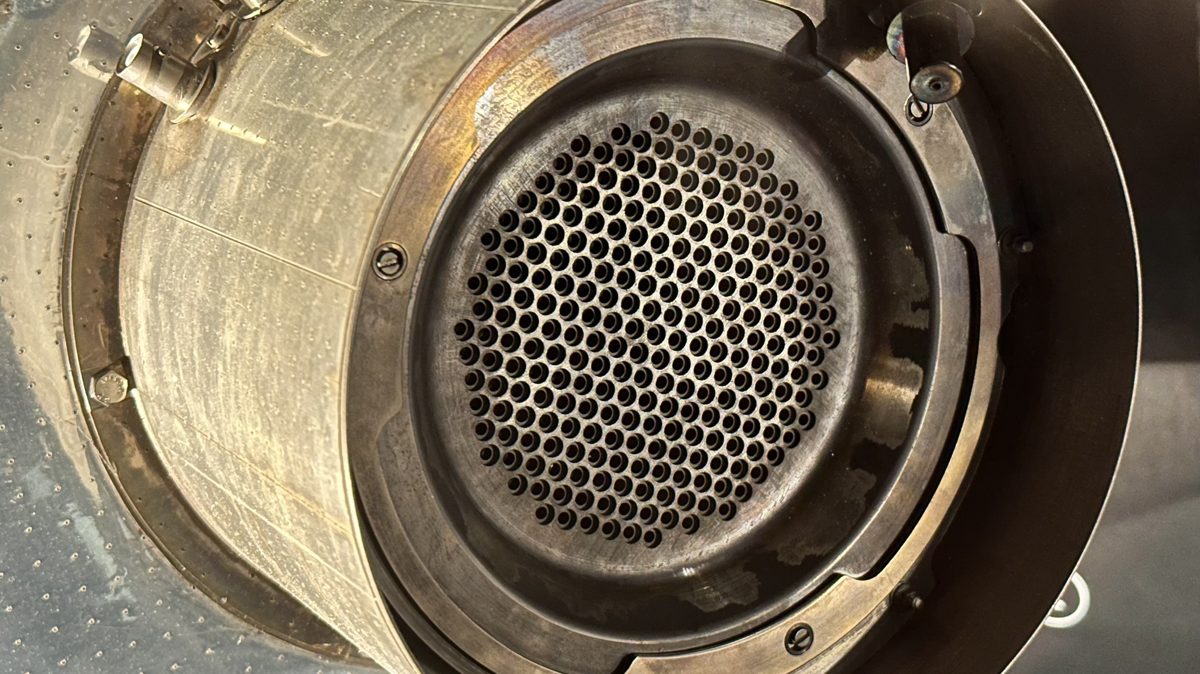
A Hall thruster uses an electric field to accelerate xenon ions into thrust. Western qualified suppliers are Busek, Aerojet Rocketdyne (now L3Harris), Apollo Fusion (now Astra) and Phase Four. Russia's Fakel imports were cut off after the Ukraine war, which tightened Western supply further. According to Payload, Redwire's CTO said the industry would need to build 100 thrusters a month to meet current demand, and 10 times more once the Space Development Agency (SDA) constellation is fully deployed. The same report said Busek, the largest supplier, is near its short-term production limit.
Supply trouble has already hit schedules. Breaking Defense reported that Astra's (Apollo Fusion's) financial trouble pushed the launch of 158 SDA Tranche 1 satellites from September 2024 to summer 2025.
The content per satellite also grows. Busek is moving from 20 units a month to triple that. Phase Four targets 300 a year and Rocket Lab 200-plus a year. Our research note says larger constellations also demand more power and thrust per unit, so count and performance rise together.
Bottleneck 2: Xenon, which few plants can make
Xenon makes up just 0.086ppm of the atmosphere. Linde says extracting krypton and xenon takes an air separation unit that handles more than 150,000 m³ of air an hour, and Linde runs more than 70 dedicated rare-gas columns worldwide. New capacity takes years.
Demand is already concentrated. A NASA and University of Southampton study found that buying 10 tonnes of propellant exceeds 10% of annual world production and distorts prices. Electric propulsion's share of total xenon demand has grown from about 10% in 2015 to about 30% now, according to our research note.
Propellant mass per satellite can fall by up to 80-90% versus chemical propulsion. But if constellations grow from dozens to hundreds or thousands of satellites, total xenon demand rises many times over.
Bottleneck 3: Power processing units and xenon filling gear
A power processing unit (PPU, the high-voltage electronics that feed a thruster) is often built in-house by the thruster maker, so there is almost no outside supply chain. Xenon filling systems also need dedicated equipment at gas companies such as Linde. As constellations grow, ground filling and test capacity must grow with them. We found no listed-company data on this layer yet.
TEMC, a rare-gas company with no confirmed satellite revenue
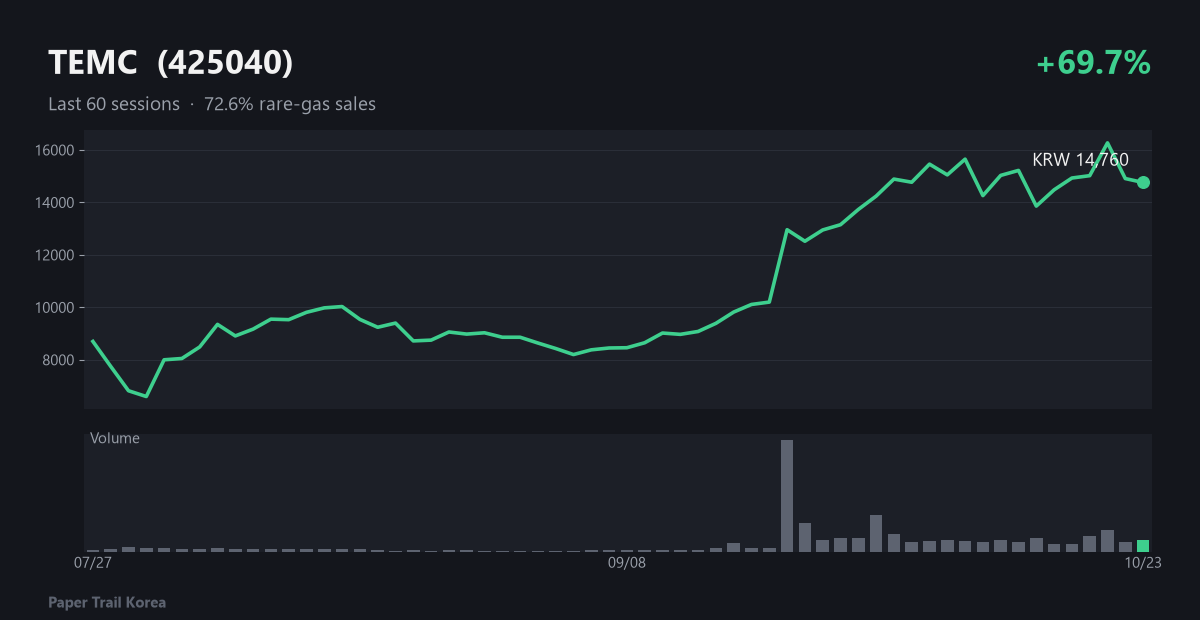
TEMC refines and sells neon, krypton, xenon and other rare gases. According to Newstomato, rare gases were 72.64% of its 67.2 billion won in cumulative sales for the first three quarters of 2022. Our research records a long-term neon purchase right from POSCO. The data does not say how much of that rare-gas revenue is xenon for satellites, and no satellite-related order is confirmed. Its latest quarterly gross margin is 18.1%, down 1.3 percentage points from a year earlier.
The stock jumped 26.3% on September 21, but no filing or article in our data explains it. There was no theme-related filing in the past month. The only recent disclosure was an October 8 exchange notice designating it an investment-caution stock after a 15-day rise with heavy buying by a few accounts. Next, watch for xenon or krypton price hikes or long-term supply contracts. POSCO's Gwangyang rare-gas plant (targeting commercial output in July 2026, per Dealsite) would make POSCO a direct supplier. A sharp drop in global neon or xenon prices, or a pullback by key customers such as POSCO, would weaken the case.
Redwire, volume plans on paper and a heavy cash burden
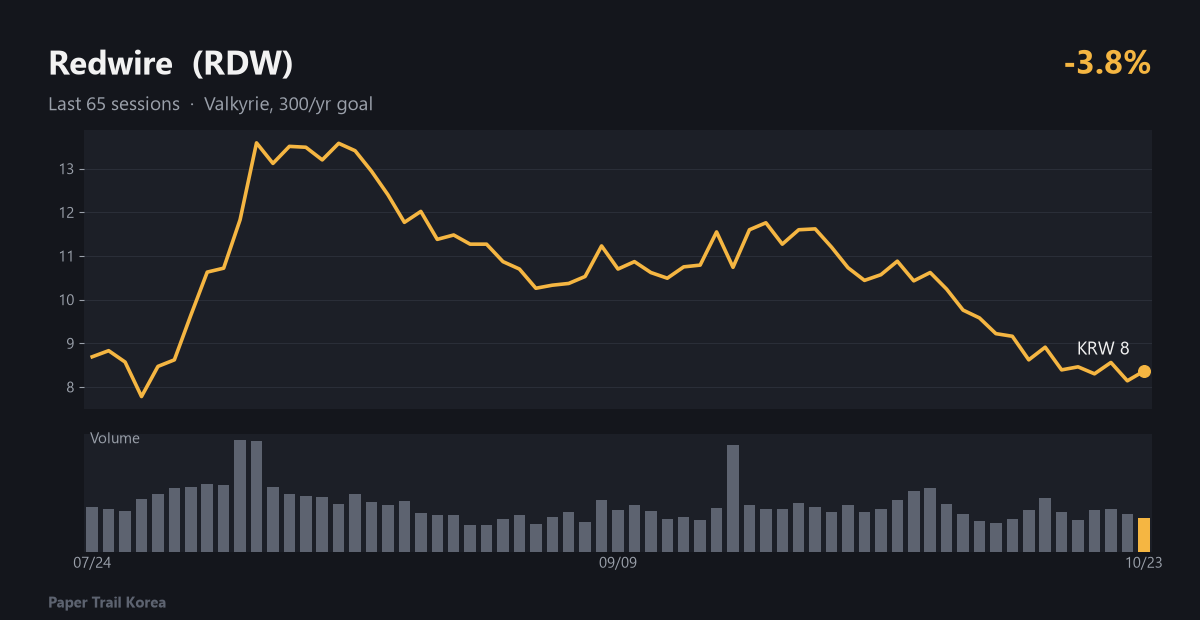
Redwire co-developed the Valkyrie Hall thruster with Phase Four, aims at the Defense Department's small-satellite supply chain and is working toward 300 units a year. Our research puts its market value at about $2.09 billion. The same record shows quarterly gross margin of 27.8%, up 58.7 percentage points from a year earlier, but a net margin of -57.3% and negative free cash flow. No confirmed thruster order appears in the data, and the share of revenue from this theme is not disclosed.
Its filings in the past week were an 8-K/A on the frequency of say-on-pay votes and an insider Form 4, neither related to thrusters. Next, check for DoD or NASA thruster orders and for Valkyrie production or deliveries. A large equity raise to cover cash burn, or lost share to Busek or Rocket Lab on price, would undercut the thesis.
L3Harris Technologies, it makes the part, but it is a small slice of the company
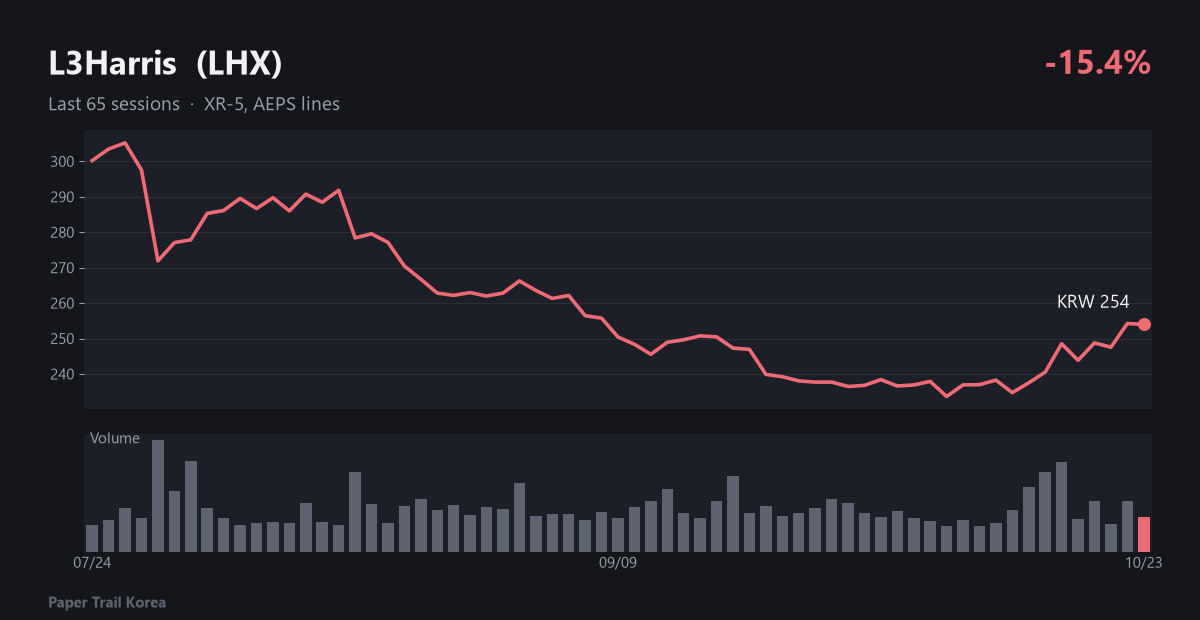
L3Harris bought Aerojet Rocketdyne in 2023 for $4.7 billion. That business had about $2.3 billion in annual revenue at the time. The Hall and ion thrusters (XR-5, AEPS 12kW) come from it. With a market value near $47.3 billion, the share of thruster sales in the whole company is not in our data. Theme revenue may be small or mixed in.
The stock sits 16.8% below its period high. Filings in the past week were an 8-K on a new independent director and insider Form 3 and 4 reports; none concerned thrusters. Next, look for thruster order filings and for segment reporting that shows how large the propulsion business is. A canceled core defense program or a rival's lower bid would also weigh.
Rocket Lab, it is building a thruster line, but launch is the core business
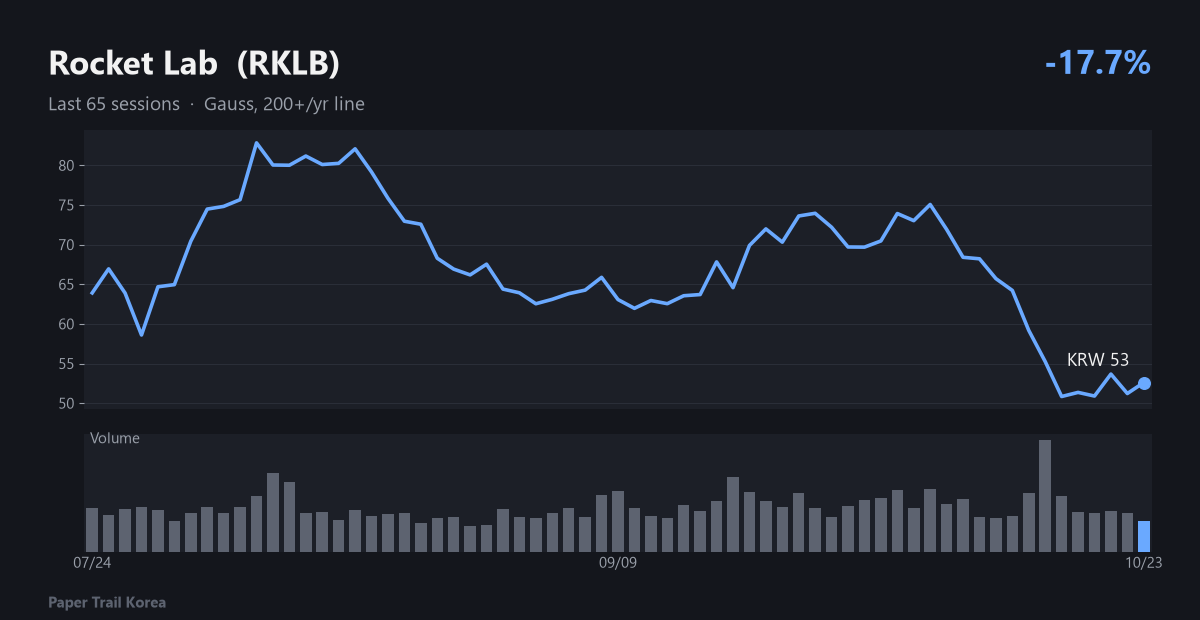
Rocket Lab unveiled the Gauss Hall thruster and said it has already built a line able to make more than 200 a year. But it is a launch and satellite company worth about $33.6 billion, so thrusters are one part of the business, and our research rates its purity as low. We found no external customer order for Gauss confirmed in a filing.
In an October 14 8-K the company said the first Neutron rocket launch would slip into next year. That is unrelated to thrusters but adds to the company's funding and schedule load. Next, watch for external Gauss orders and for the line actually running. Price competition from Redwire and Busek is another variable.
Cautions on this theme
First, theme revenue at these companies is still small or mixed. L3Harris and Rocket Lab are large, diversified businesses, and thruster share is not in the data. The satellite share of TEMC's rare-gas sales is not confirmed either.
Second, most demand figures come from industry statements and company material. The one-third all-electric figure is Air Liquide's 2016 projection. The 100-a-month and 10x figures are Redwire's CTO as reported by Payload.
Third, the xenon side shows no price signal. Our research counts zero bottleneck-related news items for TEMC in the past 30 days. Large suppliers such as Linde, Air Products and POSCO could ease any shortage if they add capacity.
Fourth, money and schedules constrain this theme apart from the bottleneck itself. Redwire is loss-making with negative free cash flow, and Apollo Fusion's (Astra's) financial trouble already delayed SDA launches. Rocket Lab's Neutron schedule has slipped.